Latest News


March 18, 2016 0

Despite pressure from all angles for stricter limits on prescription drug ads, the industry continues to expend billions on their campaigns. Sky-high spending has been continuously increasing over the past few years; surpassing the $5 billion mark this year. It is estimated that one quarter of this $5.2B came from five campaigns: Humira, Lyrica, Eliquis, Cialis, and Xeljanz. According to DTC Perspectives CEO and Chairman Bob Ehrlich, “there’s no doubt that [direct-to-consumer advertising] is now seen as almost a must-do for a drug that wants to be big”.

To read more about the controversy over pharmaceutical advertising, click here.

Lily Stauffer


March 11, 2016 0
Last week I wrote about the recovery in DTC spending in 2015. That should have been a happy event and one we all should have celebrated. Yet, another anti-DTC bill emerged in the Senate, sponsored by Al Franken and three other Democrats. This bill calls for ending the tax deductibility of advertising.
The bill will probably go nowhere based on constitutional free speech issues. Putting barriers on commercial speech uniquely for drug companies will fail. What industry will be next? Politicians do not like a lot of industries and why not limit those tax deductions as well? We know they dislike health insurance companies, gun companies, video game makers, tobacco producers, liquor companies among others.

Bob Ehrlich
“Let’s err on the side of more not less information.”
-Bob Ehrlich

What drug company executives have realized is that DTC is only one of many things critics hate about them. They know that if they stopped doing DTC to appease Al Franken, then he would still demand European prices, shorter patents, less detailing and sampling, and less tolerance for side effects. Therefore, drug makers have gone all in on DTC. They recognize that offering to give up their right to advertise a lawful product serves no purpose.

What politicians seem to think is that a public denied information is better served. They want an ignorant public because then they can influence providers and payers to avoid higher priced drugs. I have absolutely no problem with government and insurers offering effectiveness and price/value data to the public. An advertised drug may in fact not be better than a generic or non-drug alternative. Insurance companies, drug critics, government, and consumer watchdog groups are all free run counter advertising to drug ads with information on drug effectiveness, cost, and safety.

Instead politicians like Franken make the mistake of thinking the consumer is too ignorant to understand drug selection. It is a scary thought that FDA vetted advertising claims are considered dangerous and must be stopped. The rationale that $5 billion of advertising is too much in an industry that has $374 billion in sales is shaky logic. There is no impact on drug prices resulting from advertising. Advertising creates competition and consumer and doctor awareness of competing brands keeps price competition alive. Banning advertising means established brands face no DTC challenges from newcomers. Advertising certainly speeds up adoption as providers are pressured to learn about newly advertised drugs.

The drug industry cites numerous studies about advertising causing more diagnosis of disease earlier. That is a very positive benefit. Drug companies should not be afraid to also say they advertise to sell more drugs. That ability to advertise gives drug companies incentive to speed up drug development knowing they can tell the world through mass communication what they have discovered.

I know Sanders, Clinton and Franken would prefer some all knowing government agency overseeing drug development, testing, selection, and pricing. In that world of central planning, we as consumers, would have no say in drug selection. Advertising is just one source of consumer information and is of course designed to create brand requests. That is why the FDA reviews the ads for accuracy and why there are hundreds of health web sites to offer reviews of those drugs. Let’s err on the side of more not less information.

While consumers may complain about drug ads most learn about new drugs from advertising and I doubt they want to go back to the pre-1997 era. FDA is planning its first comprehensive consumer attitude survey since 2002 and I welcome that study. That could be fielded in late 2016, or 2017 as FDA moves at a government agency pace.

At the DTC National this April we will be discussing what the drug industry should do to respond to the latest threats and how marketers can influence public policy. Drug makers need to carefully balance the public concern while maintaining their right to advertise.

Bob Ehrlich


March 4, 2016 0

DTC spending continued its strong comeback in 2015, following a strong 2014. Spending was $5.17 billion in 2015 according to Nielsen, the best performance since 2007 when $5.33 billion was spent. Fueled by many new product launches, DTC advertisers spent heavily in 2015. Some of the biggest newer spenders were Xifaxan, Toujeo, Belsomra, Breo Ellipta, Harvoni, Trulicity, Jardiance, Namzaric, and Brilinta.

Bob Ehrlich
“DTC spending tops $5 billion in 2015…”
-Bob Ehrlich

The new spenders are across a wide array of categories including irritable bowel, diabetes, insomnia, COPD, Hep C, Alzheimer's, and blood thinners. Returning to the $5 billion level is a strong recovery from $3.47 billion in 2012. In 2013, the DTC recovery began with $3.8 billion followed by $4.53 billion in 2014 and $5.17 billion in 2015.

The recovery has been fueled by both new products and a realization by drug companies that DTC is essential to drug success. DTC has largely been used for large incidence categories like cholesterol, depression, and diabetes. What has been a new trend is use for more limited incidence diseases like advanced stage cancer, Hep C, binge eating, sleep disruption for the blind, and advanced heart failure.

Many drugs with high annual price tags have started to use DTC heavily. Provenge, Harvoni, and Opdivo are a few of the drugs, costing up to $100,000 a year, to begin using DTC in the past few years. DTC is now seen as a way to raise awareness of premium price drugs which are harder to get on formularies. Ads create demand and put pressure on insurers to cover those premium priced drugs.

DTC spending should continue to grow in 2016 but likely will slow its growth rate. It is entirely possible we will see the 2006 record of $5.4 billion eclipsed. This is welcome news to media companies who have counted on DTC as a key revenue contributor. With higher spending comes more criticism from the army of drug company bashers. Despite the constant criticism, drug companies are eager to advertise because DTC works in creating consumer awareness and eventual higher sales.

In 2012, some industry observers and a few pharma executives were saying DTC was dying. That pronouncement was obviously premature given spending increases in 2013, 2014, and 2015. We who work in DTC have to continue to defend the use of consumer advertising. Critics will try to take away the right to advertise and our industry must provide the positives of advertising to politicians, the media, regulators, and consumers. Clearly drug companies have shown the desire to allocate more resources to DTC and should continue to do so in 2016 and beyond.

Bob Ehrlich


March 1, 2016 0

New technology in the form vitamin-sized capsules, known as edible electronics, may be the future of colorectal cancer screening. Currently in development, such capsules can be swallowed and used to capture images inside the digestive tract. One design known as PillCam, from Medtronic, uses two mini-cameras that are capable of capturing 35 frames per second. What distinguishes PillCam is its ability to harvest images of the small intestine; a particularly difficult spot to reach with the traditional scope. Innovative as they are, edible electronics are not yet a perfect formulation. During a procedure, doctors can spot polyps and usually remove them on the spot. With a PillCam, photos can be captured, but nothing can be removed. Despite this, the FDA has approved Medtronic’s device for screening certain types of colon cancer in those not suited for anesthesia. Looking forward, researchers strive to turn these capsules into full functioning robots, which are capable of both capturing images and performing tasks.

For more information about edible electronics, click here.

Lily Stauffer


March 1, 2016 0

With a sweeping 89-4 Senate vote, Dr. Robert M. Califf was confirmed as FDA Commissioner on Wednesday, February 24th. A cardiologist by training, Dr. Califf spent years supervising clinical trials within the pharmaceutical industry. In his interview, Califf stressed the importance of using electronic medical databases as early-warning systems to identify safety lapses of drugs and devices. Further, he is adamant on the subject of identification numbers on medical devices; explaining that such numbers will allow the FDA to distinguish between minor device glitches, and those that are a major safety threat. Lastly, Califf expressed his discontent on the topic of opioid painkillers, and believes regulation needs to made priority.

To read more from WSJ about Dr. Califf, click here.

Lily Stauffer


February 26, 2016 0

There are several candidates talking about the high costs of drugs. The Republican front-runner, Donald Trump, has said in his town halls that we could save $300 billion a year by negotiating pricing through competitive bidding. Bernie says drug companies make outrageous profits and through a single payer system, he would dramatically lower costs. Hillary says there will be a monthly cap on what Americans will pay for drugs, and she will institute Medicare price controls, and end tax deductions for DTC.

Bob Ehrlich
“Expect drug marketing to disappear…”
-Bob Ehrlich

Mr. Trump has greatly exaggerated the potential savings. Medicare spent about $85 billion on prescription drugs through its Part D program in 2015. Total spending for drugs in the United States was $374 billion in 2014. Assuming price negotiation through Medicare can match Canadian prices, Medicare could save about 30% or $25-26 billion. Assuming private insurers would use these new Medicare prices to help negotiate harder, maybe they can squeeze another 10% out of drug makers. That would add another $28-30 billion.

Let’s say the public and private sector savings add to $53-56 billion annually. And for sake of argument let’s assume both Bernie and Hillary plans get the same. What happens to the drug industry losing $53-56 billion in revenue? About 85-90% of the lost revenue would be profit. That means about $45 billion. Total drug industry profits are in the $100 billion range.

What would happen to an industry that loses 45% of its annual profit? Massive layoffs in all areas of operations, relocation of jobs that remain to China and India, slashing of research budgets, and a focus on less risky drugs would occur. Bernie may think drug companies make outrageous profits but he has no experience how businesses work since he never had a regular private sector job. High risk industries need large incentives to take risks. Many drug companies fail in their research efforts and lose billions doing so.

Assuming Mr. Trump or Hillary succeed in price controls, they will turn the drug industry into a quasi government contractor. New drugs will be those that government agrees to subsidize. That means many smaller disease categories will be ignored as government will focus on the diseases that impact broad populations.

Expect drug marketing to disappear under a government dominated system. Medicare under its price negotiation authority would discourage, if not outright ban drug advertising. After all they do not want Americans to use expensive drugs. All of us in DTC will need to find other work.

There may be private innovators who still develop breakthrough drugs. It will be harder under reduced pricing and I suspect fewer small drug companies will get venture capital. Government will have an increased role in basic research and drug companies will be secondary. Nationalizing R&D sounds great to socialists, but how many new drugs came out of the Soviet Union?

An electorate hostile to drug companies may actually buy into the narrative that price controls work. Our total health expenditures are about $3 trillion in the United States. It would be shame to gut the vital drug industry for a $50 billion saving. Next time we see an Ebola outbreak, a Zika like virus, a new flu, or a drug resistant bacteria, we will want a vibrant drug industry to give us cures. While politically popular to rail against drug companies, the American people need to understand the unintended consequences from a punitive approach to drug profitability.

Bob Ehrlich


February 24, 2016 0

By Givi Topchishvili of 9.8 Group

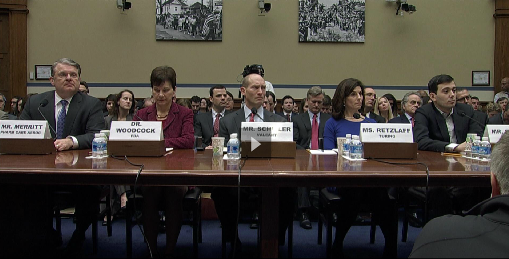
Topchishvili-Feb2016artworkLet me begin by admitting that I haven’t watched a Congressional Hearing since Michael Corleone had to stare down angry lawmakers in the Godfather Part II. Little did I know how accurately a 1974 Hollywood scene portrayed the reality I saw on 2016 CSPAN airing of the Congressional Hearing on the Prescription Drug Market. The theatrics, the drama, and emotions were so perfectly done, I had a hard time seeing the fine line between fiction and the reality. And that to me is a problem.

The policies relating to public health are highly consequential to governance and should not be taken lightly even by those of us who believe in a smaller government. Quality, access, and affordability of healthcare are vital to a society. It effects individuals and businesses. It effects government spending. It effects innovation and a major slice of the economy.

That’s why I found it perplexing that everything I saw boiled down to a show. There was a lot of self-righteous indignation, moralizing, and finger-pointing. On the other side of the isle was a perfect lineup of the worst examples of corporate greed and speculation, that happened to end up in the pharma business. It was a well-orchestrated show, evidently deeply steeped in traditions. Is that what we call leadership?

As I write this, major changes are happening in different parts of the world with regards to cost of pharmaceutical drugs. Japan, facing an aging population and a massive government debt burden, now has Prime Minister Shinzo Abe’s government insisting on price cuts on branded drugs and pushing for a speedier transition to generics. The government has said that in the next few years it would like to see generics make up about 80 percent of prescriptions in Japan from about 50 percent now. It also makes friendlier business environment for smaller companies like Israel’s Teva Pharmaceutical and India’s Sun Pharmaceutical, among others. The Japanese government identified a tangible problem and found a tangible solution.

In the UK, under pressure from consumer advocates, the government is considering overriding a patent for one major branded medication, pay its developer a compensation – process known as compulsory licensing – and authorize a company to make cheap generic copies. The case is still pending, but in a sign that the pressure is real the maker was already forced to slash pricing on the drug, although it wouldn’t disclose by how much.

Meanwhile back home in the United States, we get great reality TV of a group of lawmakers beating down on Martin Shkreli without offering any real solutions. The anticipated FDA review time for new drugs is still at least 10 to 15 months, officially, while in reality it could take years. The border to entry is still prohibitively complex and expensive. There is no mechanism in place to open the market up to more competition, or ways to expedite approval of medicines that are proven to be effective in other parts of the world.

At the same time, legal loopholes in the tax code and complex offshore schemes allow multinational entities to facilitate tax evasion. The structure of our insurance compensation policies and conjunction with HIPPA rules make it easy for some companies to charge double or triple the price as they do in other parts of the world for the same medication. That leverage is then used to undercut competition in other parts of the world, compensating for the losses at the expense of American patients and insurance companies.

Yes, there are many problems in the pharma industry, but whatever problems might exist will be easier to resolve if the government actually focused on their responsibilities and made the regulatory environment more open to transparent business practices and scientific innovation. But that takes real leadership, which is a lot more difficult than beating down on caricatures of the worst elements in any industry.

Givi Topchishvili


February 24, 2016 0

By Linda J. DiPersio, MSM, MSHC

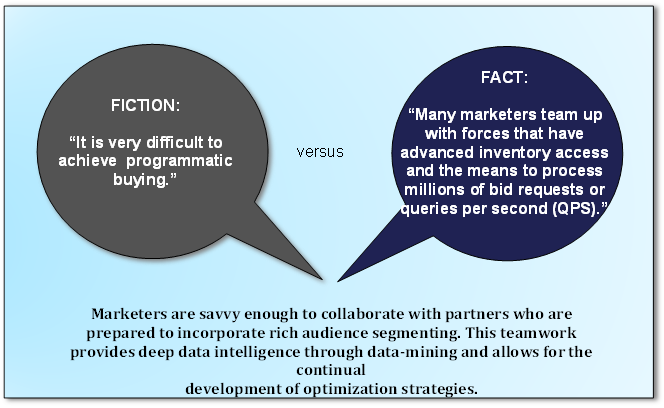
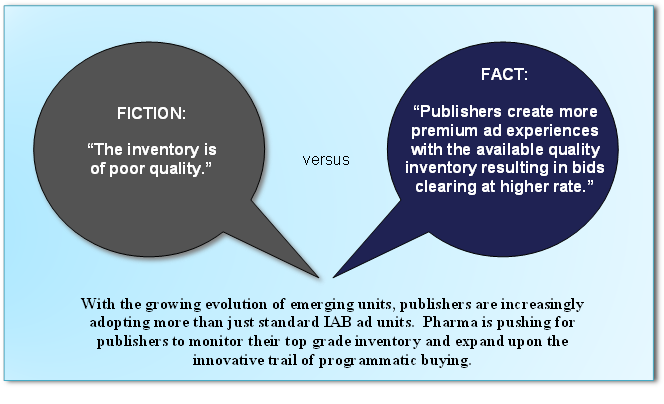
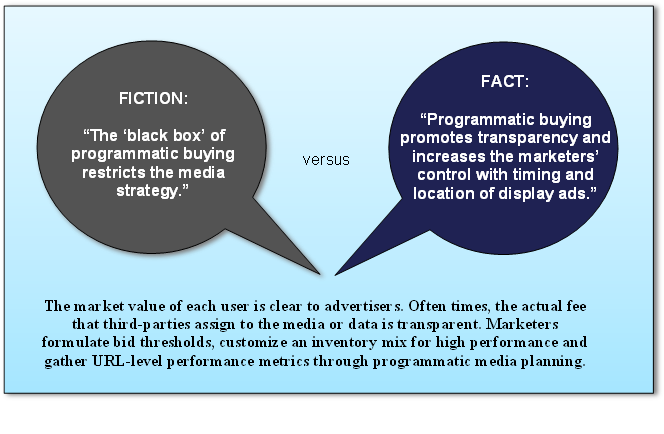
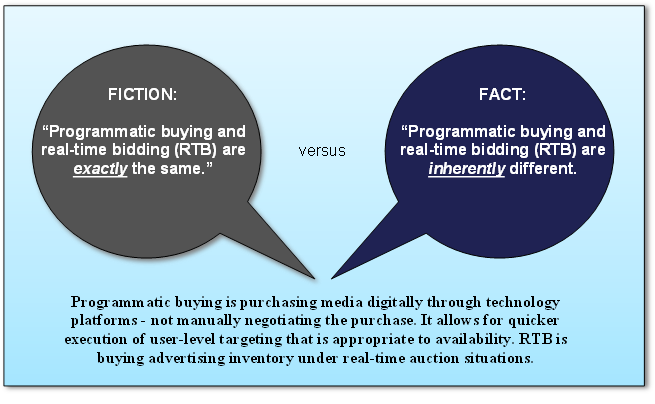
A recent eMarketer study projects that by the end of this year 63% of the overall digital display ad spending in the United States will be attributed to programmatic media buying – and this figure is estimated to soar towards 83% in 2017. In the pharmaceutical industry, programmatic buying uses software interfaces and algorithms to define and analyze specific traits of patients who have a strong inclination to purchase certain medications over others. This data allows digital ad spaces to be tailored to patients more accurately, which influences and supports a patient-centric media strategy in a positive way. The skillful use of programmatic buying within this platform not only depends on educating marketers to recognize the myths but also on encouraging them to follow the trends that will lead to an increased level of patient centricity and greater financial success and efficiency.

Fictional vs. Factual Information about Programmatic Media Buying

DiPersio-Feb2016-artwork2 DiPersio-Feb2016-artwork3 DiPersio-Feb2016-artwork4 DiPersio-Feb2016-artwork5

DiPersio-Feb2016-artwork1

2016 Trends in Programmatic Buying

Engaging Purchase-Based Targeting (PBT). With (PBT), marketers analyze segments of small groups of individuals that bought the product previously and then conduct exact image modeling to increase profits by finding more patients who are willing to buy. Behavioral and contextual data attributes enhance this digital segmentation.

Planning with Direct Automation. Advertisers create audiences inside their Data Management Platforms (DMPs) with automated guaranteed procurement. They push them directly to a publisher’s ad server that participates in user-matching.

DiPersio-Feb2016-artwork6Managing Global Frequency. Marketers effectively map users to all of their devices, match users across a myriad of platforms and determine frequency to an individual. They control their messaging and influence their bidding strategies to usher users into frequency where conversions emerge.

Bringing Talent In-House. Hiring former agencies and vendors, certifying their own technologies and retaining their own data are only a few of the ways that big marketers are consolidating talent internally. They desire an intense and direct connection to experts who specialize in programmatic buying and analysts who are focused on data science.

Closing the Loop with Data. The marketing attribution adage of “50% of my marketing works, but I just don’t know which 50%” is now showing 100% closure with organized substantiation. One example is specific beacon technology that allows marketers to actualize results with a three step process: 1) patients are alerted through social media on their mobile devices about a discount offer through social media; 2) their arrival at the pharmacy is verified and 3) data is integrated with the point-of-sale (POS) system that immediately indicates if the product was purchased.

Permitting Technology to Make Determinations. From the outset, data machine algorithms determine the exact make up and segmentation of the patient giving marketers an advanced and full understanding of the shared features of data attributes. Smoother media planning arises from automatic segment generation.

In conclusion, by understanding fact versus fiction and paying close attention to this year’s trends in programmatic buying, marketers can achieve more effective campaigns on a smaller budget and in a timely fashion. Algorithmic data analysis combined with a transparent, unbiased framework strengthens this type of buying and creates a win-win situation for the patient-centric media strategy. With programmatic buying projections, the pharmaceutical industry currently has the fortuitous chance to track the patient journey with available data delivering deeper, clearer and more concise content in the right place to the right people at the right time.


References:

Kleveno, K. “Debunking 5 Myths of Programmatic Buying.” 360i Digital Agency. (2013)

Loechner, J. “Marketers Face More Pressures Than Just Marketing.” MediaPost (2014)

O’Hara, C. “Trends in Programmatic Buying.” Media Measurement. (2015)

“Mobile Marketers Think Programmatic Advertising Is the Future So Why Aren’t They Using It?” CallFire (2015)

“A Look Inside Programmatic Pricing.” AdWeek (2015).

admin


February 24, 2016 0

DTC-National-Top-Marketers
DTC Perspectives, the leading forum for direct-to-consumer (DTC) advertising thought leaders names its 15th Annual list of the “Top 25 DTC Marketers of the Year.”

This year’s class will be honored during a joint ceremony dinner recognizing the 2016 Top 25 DTC Marketers and Hall of Fame class on the evening of April 19 sponsored byContextMedia:Health at the 2016 DTC National taking place in Boston. It includes representatives from more than 15 different manufacturing companies, with each marketer championing both the interests of the patient and brand.

“I am excited to congratulate the 2016 Top 25 DTC Marketers on behalf of the ContextMedia:Health team! It is these individuals who continue to pursue our always changing industry and wholly embrace the best technology and innovation available. We look forward to celebrating their achievements and impact on patient marketing at the upcoming DTC National Conference,” says Ashik Desai, EVP of Business Growth and Analytics, ContextMedia:Health.

The Top 25 DTC Marketers of the Year for 2016 are…

James Berger, Senior Product Manager, Entyvio, Takeda Pharmaceuticals USA, Inc.

Brittany Blair, Product Manager, Primary Care Consumer Marketing, BREO, GSK

Shawn Booth, Director, US Xeljanz Marketing, Pfizer

Jeffrey Cohen, Senior Director / Team Lead, US Vaccines, Pfizer

Elisabeth Dalton, Associate Director, Oncology Marketing, XTANDI, Astellas

Alex Dyer, Senior Marketing Director, Crestor, AstraZeneca

Brian Gartside, Sr Manager Patient Marketing, Novo Nordisk

Congratulations, Brian, from:

100x100-CultHealth-Log


Lorine Harr, Head US Reporting & Analytics, US General Medicines & Established Products, Sanofi US

Ginna Holsinger, Associate Director, Marketing Communications, Belsomra, Merck & Co.

Angela Horstmann, Marketing Director, Tanzeum, GSK

Michael Jafar, Senior Director Strategic Marketing & Communications, Allergan

Terri-Lynne Jones, Senior Product Manager, Psychiatry Marketing, Lundbeck

Nicole Kloevekorn, Director, Chantix US Marketing, Pfizer

Debra Marchese, Executive Director, Marketing, Linzess, Actavis

Allyson McMillan-Youngblood, Director of Immuno-Oncology Franchise, Bristol-Myers Squibb

Ryan Mihalik, Associate Director, Urology Consumer Marketing, Astellas

Megan Morrison, Senior Product Manager, Amitiza, Takeda Pharmaceuticals USA, Inc.

Dan Pinto, Associate Brand Director, Novo Nordisk, Inc.

Andrea Porzio, Director, HCV Marketing, Gilead Sciences

Vasanthi Ratnathicam, Group Product Manager, Tamiflu, Genentech

Carey Reynolds, Product Director, US Eye Care – RESTASIS Consumer Marketing, Allergan

Holly Rosenthal, Senior Director Marketing, Jublia, Valeant

Tatyana Tsinberg, Senior Director & Team Leader, VIAGRA, Pfizer

Aylin Utke, Product Director, Diabetes Alliance, Eli Lilly

Libby Wlochowicz, Director, Consumer & Multi-Channel Marketing, Amgen

“These elite pharmaceutical marketing professionals are this year’s top contributors to the advancement of patient outcomes via direct-to-consumer pharmaceutical education and marketing,” added DTC Perspectives Chairman and CEO Robert Ehrlich. “We would like to recognize the faces behind prominent DTC campaigns, because their hard work and dedication to fostering the industry is often not recognized. The awardees were selected from many worthy candidates.”

DTCN15-TopMarHof67

Select honorees will also participate in a panel discussion on current DTC marketing issues at the DTC National Conference, held April 19-21 at Sheraton Boston.

Click here to register for the DTC National Conference or contact the DTC Perspectives office at 770-302-6273.


Celebrate with the Industry’s Best

Congratulate the Top 25 Marketers and Hall of Fame inductees in-person and in our publications!  DTC Perspectives offers reserved tables with seating for 10 at the Top 25/Hall of Fame and Advertising Awards ceremonies as well as congrats ads opportunities in our DTC Perspectives Magazine/DTC National Conference Guide, on our website, and in Email announcements.  Click here to view awards packages and congratulate a Top Marketer/DTC Hall of Fame inductee today.

[button link=”https://form.jotform.com/60534052495959″ color=”red”]Purchase Congrats Ads and Reserve Dinner Tables[/button]

admin