It’s probably safe to say that you’ve been to the doctor at least once in your adult life. So you can probably relate to this:
You’re sitting on the exam room table in your physician’s office. In your head, there’s a lengthy list of questions related to the reason for your visit – an aching back, perhaps, or persistent heartburn, maybe a minor sprain – and you’re hoping you don’t forget any of them. Your doctor walks into the exam room after what feels like an eternity, even though it’s probably only been 10 minutes, and asks, “How are you today?”
“I’m fine,” you answer.
You’re not alone! Doctors say this is a common scenario … and one that makes effectively treating patients all the more challenging. “I’m fine” has become a default response.
One of the most important interactions individuals can have is about their health. But empowering patients, educating them to take control of their health – avoiding the default “I’m fine” answer – is one of the greatest challenges DTC marketers face. In fact, it’s one of the greatest communication challenges in healthcare, period.
It’s also one of the greatest opportunities. So how can you overcome that challenge? Where do you start?
In my opinion, the most effective way to overcome communication challenges starts in the exam room. And it’s so critical to the patient, the physician and the pharmaceutical marketer to get that interaction right.
I call it the “magic moment.” It’s that moment in the scenario I described above, right before the doctor comes in. You’re sitting on the crinkly-paper exam room table (with your phone put away!). You look up and see a display of approachable, aspirational brochures. Or maybe it’s a mounted digital device that invites you to learn more about your symptoms with a few taps of your fingertips. The privacy of the exam room is a safety net where you can learn more about the reason for your visit, arm yourself with questions for your doctor and feel empowered to discuss your diagnosis after engaging with meaningful, condition-specific education.
What constitutes meaningful education? Easy-to-understand, for starters. Eighty-seven percent of U.S. adults read at an intermediate level or lower, so materials are most effective when written in what health literacy experts call “plain language” – a fifth-grade reading level, at most.[1] It’s easy for us as marketers to lose sight of this and go for the more complex messaging, but if patients can’t understand what we are saying, they won’t be empowered to ask the right questions.
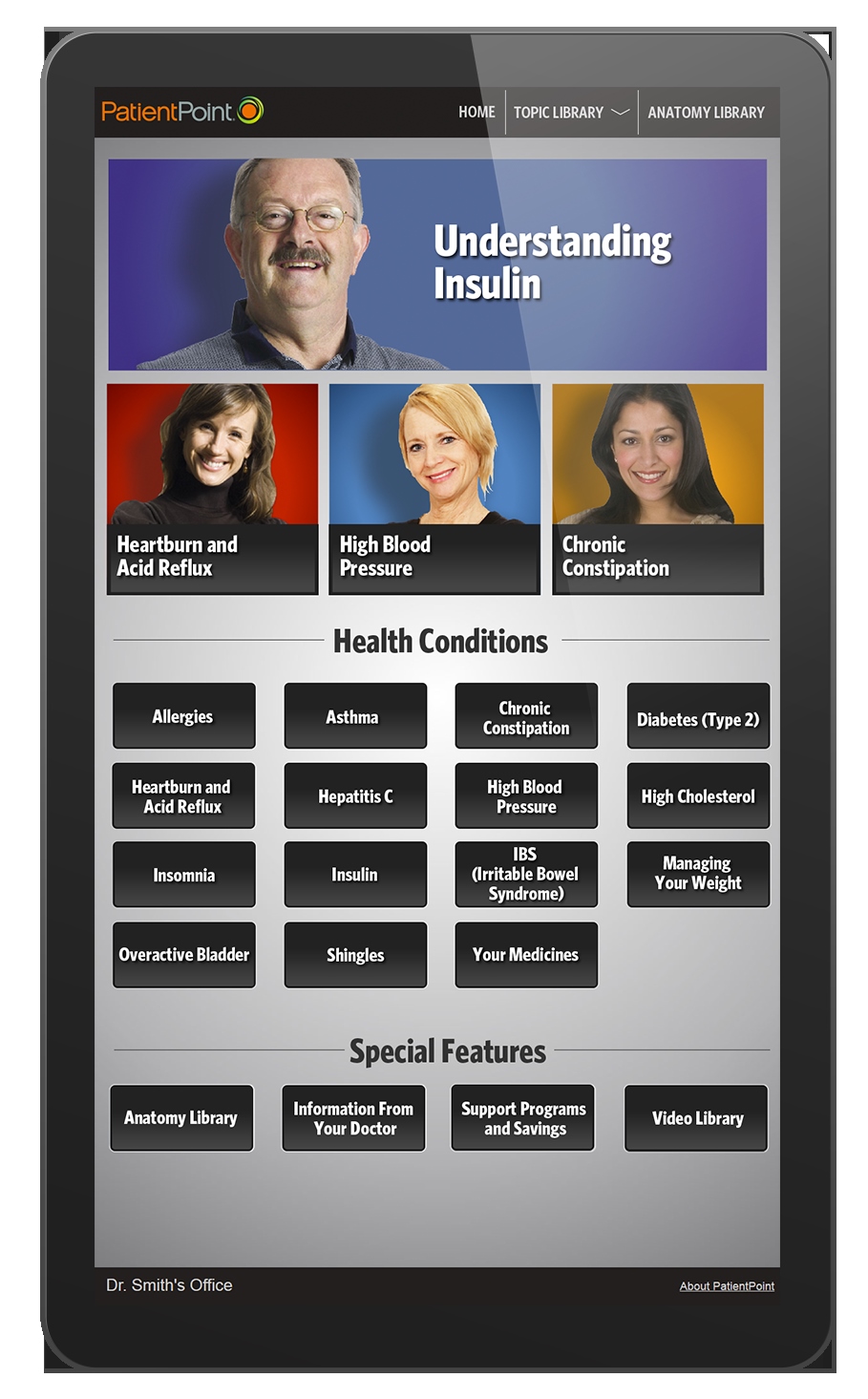 Then there’s the medium itself, which can also make patient education more meaningful: interactive touchscreen technology, engaging videos and, yes, even print – each medium is particularly effective for certain patient demographics. All serve as an opportunity to appeal to a patient’s learning preference and to provide a guide to a patient’s condition.
But content is also key. The most meaningful exam room education addresses not just the condition, but the underlying causes, lifestyle management and treatments as well. Treatment options will obviously vary depending on the condition and the progression of the disease state – so education must help patients learn how to communicate with their doctors throughout their diagnosis and journey.
This approach works. According to PatientPoint results, 9 out of 10 patients learned a tip they could take action on from our exam room education, while 96% of patients agreed we make health information easy to understand.[2] This translates into 5 to 1 ROI and 11% NRx average lift.[3]
So the next time you’re in your doctor’s office, sitting on that crinkly-paper exam room table, take a look around. Look for information that’s meaningful and draws you in. If you’re seeing one of the healthcare providers that such provides such resources, it’ll be there, ready to empower you to take control of YOUR health.
References
[1] Static Brain, “Illiteracy Statistics.” 2014.
[2] PatientPoint national survey. 2015.
[3] Symphony Health Solutions. 2015.
Managing social media in the healthcare space can be challenging and must be approached with a unique strategy by brands. In my experience, a brand’s objectives for organic social media can run the gamut from listening and research, to marketing and engagement, to sales and CRM. (Not all at once, thankfully.) I'm focused on achieving success in the organic space, and leveraging insights to optimize a brand's paid social spend. However, in my research on the health industry, it often seems that companies eschew interaction on social platforms, with their best case scenario avoiding any kind of pique or penalty. As such, too many paid social efforts appear unfitted based on the audience they are serving.

Somewhat inevitably, this approach leads to a disregard for several social media fundamentals – authenticity, balance, connectivity – a scheme not ideal for controlling the message. To be fair, it’s a not a universal failing, for I did come across some modestly successful provider-as-lifestyle-partner posts, and message boards with brand-as-facilitating-host. My first impulse was to diagnose a vicious cycle where lack of resources or talent led to a subsequent deficit in results, which in turn ensured a steadfast lack of commitment, and caused the under-investment in resources.
Learning the primary root of social media anxiety in pharma
I read industry blog after industry blog, which led me to the FDA’s Guidance for Industry documents. It is clear those drafts are daunting. During a recent poll conducted at an industry event, 95% of respondents cited compliance as the root of their reluctance to participate in social media. It was not a lack of resources, nor talent, and not a difficulty in measuring ROI.
Understanding the FDA and compliance
Knowing the reason why most companies are reluctant to add paid social as a channel, I decided to read every line and footnote in each draft guidance from May 2009 to June 2014. I read every warning letter or notice of violation stemming from digital media over the past six years. I studied the FD&C Act and the Electronic Code of Federal Regulations. I evaluated the advertising policies for each major social platform, even though I’m not a media buyer. I absorbed Mark Senak’s white paper, FDA Communications Oversight in a Digital Era, too. Finally, I called the FDA.
My own point of view is that exposure to warning letters, notices of violation, or adverse events occasioned by social marketing, is evidently overstated. By my calculation, since 2009, the Office of Prescription Drug Promotion at the FDA have issued only three WLs/NOVs specific to social media. As for the reporting of adverse events, I won’t make the mistake of downplaying their function. But I will say that of the sample studies I’m aware of, on average only 3% of posts include each of the four elements required for their reporting. That’s a low number, whichever way it’s spun. I did not discuss my views with the FDA, and the FDA was not able to answer all of my questions. However, I emerged from that conversation with clarity.
We talked about social media platforms with character space limitations (Facebook ads are character-limited). I also asked about reminder advertisements and reminder-like ads (which you should read more about, from the Food & Drug Law Institute’s Advertising & Promotion Conference, in October 2014).
What’s the risk?
The central tenet of my theory after the research, is that there is risk associated with any communication, but the notion that social media is some kind of unnavigable domain doesn’t stand up to scrutiny. The legal and regulatory culture is different at every organization and remaining in compliance is no easy task. Yet when a majority of violations are for omitting (or minimizing) risk, or because of unsubstantiated claims, one wonders how the content found its way out the door? It is possible that small firms will take more chances, but when bigger players are using self-denial as a form of discipline, neither strategy provides the means to achieve meaningful ROI from social.
The solution with social media has to be audience-first.
There are powerful listening and analytics tools that reveal a target audience: who the audience is, what the audience wants, when they want that, and how often to deliver it. This information forms the bones of a basic social strategy which is allied to an objective. Regardless of whether it’s Pharma/Rx, OTC, or HCP, the underlying objective is conversion. Successful conversion is best achieved by understanding the organic audience, which in turn improves paid-social creative, targeting, and performance.
For this to work at scale, I’d recommend becoming familiar with the June 2014 Guidance for Industry , the forthcoming use of links to third party sites, and understanding how a reminder or a reminder-like ad can be customized and tested, be creative but not careless.
In terms of the big picture conversation; if other industries are deploying custom contact strategies, why isn’t health? The most enduring social relationships originate from empowering exchange.
I was a strong supporter of the Novartis heart failure disease awareness ad. This was the one with the man in the room with water pouring in and filling up the room. It was criticized by some doctors for being alarmist. I never thought so myself, as heart failure is about as serious cause for alarm as there can be.

The disease ad was a precursor to a branded ad for Entresto, which I can’t stop thinking of as Ernesto. This ad is the polar opposite in tone to the disease education campaign. While the message of preventing heart failure is the same, the branded ad takes an uplifting approach.
The ad uses the song from Annie, “Tomorrow” which I guarantee you will sing for at least 24 hours after seeing it. It is a series of patient vignettes where the actors sing parts of the song. The message is that Entresto will help make more tomorrows possible. The commercial is beautifully simple and engaging.
I have to give Novartis and their agency, McCann, a lot of credit for a combination of disease and branded ads so different yet entirely complementary. The disease ad really stopped you in your tracks alerting viewers that heart failure is something to watch out for and act on. While deadly serious in tone, I think it was entirely appropriate. They could have used the same idea for the branded ad but they smartly chose to play up the positives. It is better to promise in the branded campaign hope about living longer than warning about early death.
What was necessary in the disease ad to get your attention was not the best approach in the branded ad. Instead showing a world of family and friends that you can enjoy longer if you treat with Entresto was a good approach. I am sure the doctors critical of the disease ad had the opposite reaction to the “Tomorrow” campaign.
I am not sure whether the criticisms from the medical community affected the branded strategy. Maybe that led to the decision to go more upbeat. In any event, whatever the reason, Entresto is a solid ad that is memorable and positive
I wanted to explain why after 16 years of developing conferences we decided to run one solely on tv and print this fall. It seems odd that the media with the most spending seems to get the least discussion on the agenda. Our DTC National offers a wide array of topics but most are in new media. I always ask people to submit speaking proposals on television and print but few are received. While drug marketers are anxious to learn the latest on new media, there is a lot that can be improved in the meat and potatoes category.
-Bob Ehrlich
Most of our speakers are on digital, big data, patient relationships, point of care, and technology. While this may be the DTC future, the overwhelming media allocation remains in television and print. After 20 years maybe there is not much left to learn in mass media. I kind of doubt that.
We are seeing great new creative in mass media so clearly agencies and clients are learning how to constantly improve their ads. We are also learning so much more about patient receptivity to ads depending on day part, show type, and where the ad is in the show. We are seeing FDA doing many studies on elements of advertising from supers, cartoon images, how risk is narrated. We are getting new research that dissects effectiveness to new levels of detail.
We are also experiencing growth in mass media for drug categories that never would have used it a few years before. Cancer and rare diseases have decided that the ROI is positive using mass techniques. So there seems to be a renaissance in expanding use of mass media.
We also see print titles doing quite well. DTC ads dominate some magazines. I have always believed there is tremendous opportunity to improve the creative impact in print. Too many ads are still missing a dominant headline or visual, choosing dense copy and too many sub headlines. While FDA mandates make print more difficult, there is no reason any ad should not be visually arresting.
My guess is every media plan can be 10-20% more effective with some simple tweaks. Better creative, more pre-testing, more targeted media planning, and more robust evaluation are all possible and affordable. In 20 years of being involved in DTC I have seen many campaigns that I know are weak, yet somehow they made it on air. Mediocre ads get through for many reasons. It can be bad copy strategy, testing the wrong objectives, rushed creative, forgetting the competitive set, group think, overloading information, or many other factors. Sometimes there is so much testing that the marketers are overwhelmed and miss the need to simplify for consumers.
So in October we will do an entire conference that never mentions social media, mobile, relationship marketing, or personal fitness devices. Instead we will focus on making our tv and print ads better, spending more effectively, and doing better analysis. I am not pushing mass media over new media, just recognizing that if more than 80% of our budget is spent there, we might as well strive to do it better.
By developing and implementing solutions for handling adverse events in social media, your company has the opportunity to leverage key information from the largest focus group in the world.
In my previous column, I discussed how social media can be viewed as a “perpetual focus group.” The sheer and ever-expanding volume of these conversations represent a virtually infinite set of data that can be transformed into valuable information. All of this information — even Adverse Events (AEs) and Product Quality Complaints (PQCs) — can provide insights that power decisions and support action.
The role of adverse events on social media
Social media, like any other media, is a source of AEs and PQCs. Given the immense volume of tweets, Facebook status updates, Instagram photos, blog posts, and conversations on forums, it is to be expected that while people are sharing their health experiences, AEs and PQCs are bound to be mentioned. These can occur either intentionally (for example, “I took Drug Rx and I woke up to a rash on my leg”) or incidentally (“I’m so grateful for the nurses who took such good care of me when I was in the hospital after my car accident. Also, Drug Rx has been working well for me.”).
Since the early days of social media, there have been two opposing schools of thought on the best ways to handle AEs on social media. One school of thought views AEs as an absolute obstacle to any pharmaceutical company getting involved in social media. The other school does not view AEs as a problem, but rather, in my opinion, projects a nonchalant attitude about the nuances of social conversations and the identification of AEs.
I am not a student of either school of thought. Based on my professional experience within clinical settings and my knowledge of drug safety, I believe the best stance is to acknowledge the challenges that AEs present while, at the same time, to develop and implement practical day-to-day solutions — systems that ensure proper identification and triaging of AEs, as well as the ability to leverage AEs for analytics and insights.
How to monitor and categorize adverse events
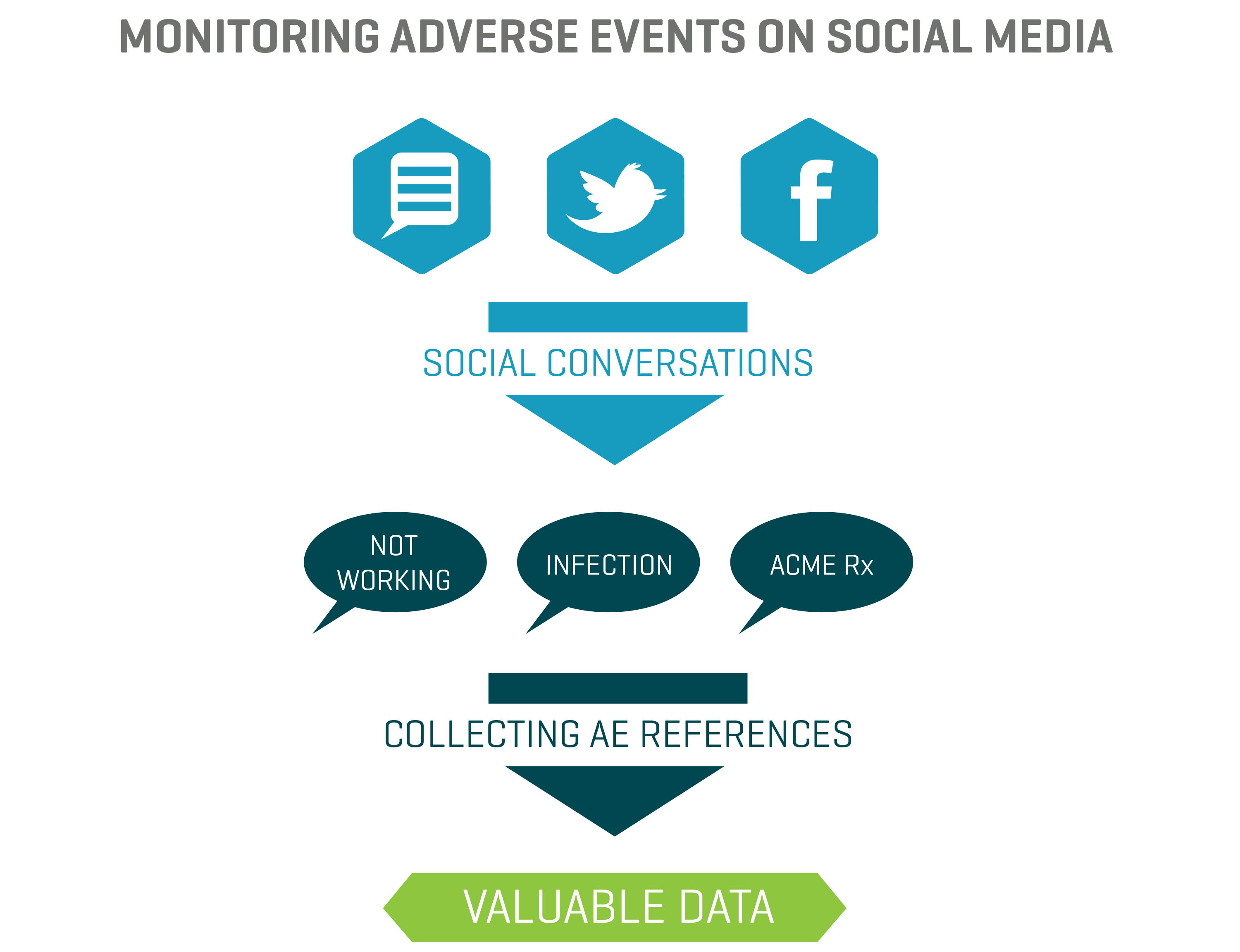 Fundamentally, AEs can yield useful information when monitored closely, safely, and properly. Over a period of several months, for instance, thousands of AE posts can be classified according to an objective-based process. Then, identified and triaged appropriately, these AEs can be classified into categories.
Let’s explore one example: “Drug Rx has been a life-changer for me. So far, it’s been doing what my doctor says it’s supposed to do. Occasionally, I get a little rash on my right arm, but other than that, I'm truly grateful.”
In this scenario, we have an AE (assuming we can identify the person reporting it). We also have references that can be classified. “It’s doing what my doctor says it’s supposed to do” could be classified as Effectiveness, and “a little rash” could be classified as, say, Immunity. Over time, these AEs can help companies better understand conversations. At the end of the set time period, a company may find that 50% of AEs were Immunity-related, 25% were Cardiovascular, 15% were Respiratory, and so on — providing valuable information for understanding the adverse side effects of a particular agent.
Furthermore, if these posts were also categorized by other data, such as the social media outlet, the topics discussed and the behaviors expressed, the aggregate data offers information beyond purely clinical, perhaps even helping to inform a company’s messaging or marketing strategy.
Establishing well-defined protocols for success
The above example illustrates the basic concept of leveraging social media AE data. In essence, the close monitoring and careful categorization of social media AE data can transform a seemingly complex and vast landscape into a navigable road. But that’s not to ignore the challenge of scalability. The best approach is to start small, evaluate results and evolve incrementally.
Companies need to plan for how they will monitor social media for AEs, because the greatest pitfall is missing AEs altogether and risking patient safety. Training staff in the identification of AEs and the enterprise’s triaging protocol is crucial. In my company’s training program, our agents receive training in the nuances of social media, in addition to traditional AE and PQC training, to ensure they do not miss AEs. After identification, the documentation and communication protocols need to be established and clearly understood by all team members.
The first step of merely identifying AEs can be challenging within itself, as information related to AEs or potential AEs are often ambiguous or sparse, especially due to the word or character limitations on certain social media platforms, such as Twitter. Furthermore, a company cannot publicly respond to a tweet that simply says, “My inhaler isn’t working” by asking, “What do you mean by working”? So the company is left wondering, is this an AE (lack of efficacy), a PQC (a malfunction), both an AE and a PQC, and/or an opportunity for patient education? In the inhaler example, the company could respond with, “We’re interested in learning more. Please contact us at 800-555-5555.” This is where the pharmaceutical company’s ability to interact publicly in social reaches its limit, but still presents an opportunity to demonstrate a caring, human voice, while adhering to regulations. Training must include steps for evaluating an AE and how to extract the key data.
Exploring ethical implications
Because the general principles of monitoring for AEs also apply to social media, compliance with FDA regulations is, for the most part, straightforward. Yet beyond the regulatory responsibilities of AEs, ethical issues arise. For example, it is inevitable that companies may stumble upon mentions of a competitor’s agent with a potential AE, either on their own branded properties or within the broad social media space. Companies are not required to report another company’s AEs to the FDA, but should they? Well-established processes, understood by all within a company, can help guide these and other ethical decisions.
Pharmaceutical companies are committed to patient safety, product safety, and effectiveness. By investing in and developing resources to ethically and efficiently manage AEs on social media, companies can transform the fear of these AEs into mutually beneficial results. In the long run, better understanding of all AEs — social media or otherwise — can help expand the knowledge of drug researchers, providers, and marketers; advance the industry; and improve the well-being of the patients we serve.
Treato, an online consumer insights company, released a survey on DTC 4/18. It was done with 529 Treato.com consumer users. The headline in their press release that said “Treato Finds DTC Pharma TV Advertisements Have Little Influence”. They cite a result that only 7% of respondents asked their doctor about an advertised drug this year compared to 21% last year.
When you do a survey and get some strange results like a decline from 21% to 7% you have to ask why. There is no reason that consumers would react so differently year to year. You have to question the methodology, the panel who responded, or some other factor. People would not find 2015 advertising so much less influential than 2014 advertising.
Treato did not analyze what TV ad influence means in terms of ROI for drug companies. Television ads payback, and the evidence is overwhelming. Whether the real consumer request number is 7%, 21% or anywhere in between, the drug makers look at the value of consumers who do request based on their ads. For many branded drugs 7% would be a great number.
The drug industry does not expect their ads to influence a majority or even a large minority of consumers. They know most consumers rely entirely on their doctor to tell them which drug to use. The drug makers hope a large enough segment of a potential user population see an ad and ask their doctor.
I remember the launch campaign for Lipitor had a marginal share boost. That marginal boost, however, was a great ROI on our investment. So Treato may be correct that TV has less influence than the DTC critics give it credit for having. Maybe Hillary will see that DTC is not the force for evil she contends in her speeches.
When you examine any blockbuster drug performance DTC has a marginal influence. Lipitor spent about 100-150 million on DTC in its peak days. It was doing over 5 billion in sales. So it probably generated 200-300 million in incremental sales from DTC. Maybe it had 4-6% influence. I think that percent would be a fair estimate for most billion dollar plus drugs doing television DTC.
Treato suggests that drug companies look for other ways to influence consumers. This statement misses the ROI truth. Drug marketers will use any medium that pays back. Television may not be seen by media pundits as innovative, but drug marketers are evaluated on ROI success, not how much they experiment. Television ROI is less than some other more targeted techniques like Point of Care. Drug companies do both to achieve their goals.
So Treato’s headline has some truth despite the odd decline they state from 21% to 7%. Their term “little influence” has very different meanings to drug company marketers and DTC observers. A little influence can generate a great ROI on premium priced drugs. For most brands’ mass media plan it is 1.5 to 3 to one. Pharma lobbyists should tout this survey to DTC critics showing there is no need to be concerned that consumers are being hypnotized by television into mass use of drugs.
The leading forum for direct-to-consumer (DTC) advertising thought leaders honored a dynamic group of pharmaceutical companies and brands at the much-anticipated DTC National Advertising Awards. The awards were part of the 16th Annual DTC National Conference to be held April 19-21 in Boston. Sponsored by Health Monitor Network, the 2016 Advertising Awards showcase the best marketing and advertising across 16 categories.
The 2016 Ad Awards showcase exemplary work spanning multiple media and strategic categories. During the Advertising Awards Dinner held on April 20, Gold, Silver, and Bronze winners were announced for all 16 major categories and a best Overall campaign winner was chosen.
Please contact Jennifer Kovack (Jennifer@dtcperspectives.com) with any awards inquiries.
[button link=”https://www.dtcperspectives.com/dtcn/#tickets” bg_color=”#700510″]Register for DTC National[/button]
[button link=”https://form.jotform.com/60534052495959″ bg_color=”#383838″]Reserve Awards Dinner Table[/button]
Ad Awards presented by: 
Television category presented by: 
Gold Winners
Silver Winners
Bronze Winners
Honorable Mentions
| BRAND, DISEASE STATE, OR PROGRAM | COMPANY/IES | AGENCY/IES | |
| BEST BRANDED TELEVISION CAMPAIGN – Presented by CBS | |||
| BREO Ellipta | GlaxoSmithKline | HAVAS Worldwide Tonic | |
| Chantix | Pfizer | Y&R | |
| Farxiga | AstraZeneca | MRM//McCann | |
| Harvoni | Gilead Sciences, Inc. | STRIKEFORCE Communications, LLC | |
| Humira (RA) | Abbott | Publicis New York | |
| Jardiance | Boehringer Ingelheim & Eli Lilly and Company | Evoke Health Philadelphia | |
| Jublia | Valeant | JUICE Pharma Worldwide | |
| Linzess | Actavis/Ironwood | FCB Health | |
| Lyrica (Fibromyalgia) | Pfizer | J. Walter Thompson | |
| Myrbetriq | Astellas | Pathway, FCB Health, & Katalyst | |
| Namenda XR | Actavis | FCB Health | |
| Opdivo | Bristol-Myers Squibb | J. Walter Thompson | |
| Osphena | Shionogi | Publicis New York | |
| Prolia | Amgen | FCB Health | |
| Viagra | Pfizer | BBDO/RAPP | |
|
|
|||
| BEST BRANDED PRINT CAMPAIGN | |||
| BREO | GlaxoSmithKline | HAVAS Worldwide Tonic | |
| Depuy Synthes | Anderson DDB Health & Lifestyle | ||
| HARVONI | Gilead Sciences, Inc. | STRIKEFORCE Communications, LLC | |
| JARDIANCE | Boehringer Ingelheim & Eli Lilly and Company | Evoke Health Philadelphia | |
| Levemir | Novo Nordisk | Prime Access | |
| Linzess | Actavis/Ironwood | FCB Health | |
| Nexplanon | Merck & Co., Inc. | DDB | |
| OPDIVO (nivolumab) | Bristol-Myers Squibb | J. Walter Thompson | |
| OTEZLA | Celgene | Evoke Health New York | |
| Prevnar 13 | Pfizer | Y&R New York | |
| Tamiflu | Genentech | HealthWork, powered by BBDO and CDMI | |
| Tanzeum | GSK | AndersonDDB | |
| Tecfidera | Biogen | CDMiConnect | |
| VIAGRA (sildenafil citrate) | Pfizer | BBDO/RAPP | |
| Xeljanz | Pfizer | Y&R | |
| BEST BRANDED WEBSITE | |||
| Actemra | Actemra | CDMiConnect | |
| Belsomra | Merck & Co., Inc. | Y&R Group–Wunderman DC | |
| Brintellix | Takeda & Lundbeck | ||
| HARVONI | Gilead Sciences, Inc. | Evoke Health New York | |
| Humira | Abbott | Digitas Health | |
| JARDIANCE | Boehringer Ingelheim & Eli Lilly and Company |
Evoke Health Philadelphia | |
| Linzess | Allergan/Ironwood | FCB Health | |
| NAMZARIC | Allergan, Inc. | FCB Health | |
| OTEZLA | Celgene | Evoke Health New York | |
| Prevnar 13 |
Pfizer | Y&R New York | |
| RESTASIS® | Allergan | Beacon Healthcare Communications | |
| Tamiflu | Genentech | Havas Worldwide San Francisco | |
| Tecfidera | Biogen | CDMiConnect | |
| Ultrashape | Syneron | AbelsonTaylor | |
| VIAGRA (sildenafil citrate) |
Pfizer | BBDO/RAPP | |
| BEST BRANDED DIGITAL / SOCIAL CAMPAIGN | |||
| Botox (Cosmetic): Treatment Visualizer |
Allergan | ||
| Entyvio | Takeda | Klick Health | |
| EPIDUO | Galderma | Deutsch | |
| Gilenya | Novartis | FCB Health | |
| Invokana | Janssen | Hill Holliday (GA) / Casanova Pendrill (Multicultural) | |
| Myrbetriq: The Momentum Program |
Astellas | PulseCX, 2nd Spark, Targetbase, Pathway |
|
| NuvaTime Reminder Tool |
Merck & Co., Inc. | Saatchi & Saatchi Wellness | |
| OTEZLA – Psoriatic Arthritis (PsA) |
Celgene | Evoke Health New York | |
| OTEZLA Psoriasis |
Celgene | Evoke Health New York | |
| Prevnar 13 |
Pfizer | Y&R New York | |
| Simponi Aria HotSpot Rx |
Janssen Biotech, Inc. | J3 | |
| VIAGRA (sildenafil citrate) |
Pfizer | BBDO/RAPP | |
| BEST DISEASE EDUCATION TELEVISION CAMPAIGN | |||
| Binge Eating Disorder | Shire | Digitas Health LifeBrands | |
| Circadian Rhythm Disorder | Vanda Pharmaceuticals | Merkley + Partners | |
| Heart Failure | Novartis | McCann HumanCare | |
| Hep C Hope | Gilead Sciences | STRIKEFORCE Communications | |
| HIV Testing | Gilead Sciences | Digitas Health LifeBrands | |
| Lung Cancer | Bristol-Myers Squibb | MRM//McCann | |
| Opioid Constipation | AstraZeneca | BGB Group | |
| Pseudobulbar Affect (PBA) | Avanir Pharmaceuticals | Advance MarketWoRx | |
| Shingles | Merck & Co., Inc. | Publicis New York | |
| Whooping Cough Vaccine | GSK | Ogilvy CommonHealth/Backe Marketing/PHD Media | |
| BEST DISEASE EDUCATION PRINT CAMPAIGN | |||
| Caregivers Speak Up |
The Bloc | The Bloc | |
| Chronic Migraine |
Allergan | Saatchi & Saatchi Wellness | |
| Diabetes Sight Risk |
Regeneron | The Bloc | |
| Heart Failure | Novartis | McCann HumanCare | |
| Lupus | GSK | Anderson DDB | |
| My HIV Hangup |
ViiV Healthcare | Havas Worldwide Tonic | |
| Patient Advocacy |
Eisai | Medikidz/Marina Maher Communications |
|
| PBA Facts |
Avanir Pharmaceuticals | Advance MarketWoRx | |
| Prepopik Unbranded CRC Campaign |
Ferring Pharmaceuticals | Concentric Health Experience | |
| Prostate Cancer Unbranded Disease Awareness |
Bayer | Area 23 | |
| Tdap Awareness |
GSK | Ogilvy CommonHealth/Backe Marketing/PHD Media |
|
| BEST DISEASE EDUCATION WEBSITE | |||
| Afib Microsite |
Daiichi Sankyo | Spirit Health Group, National Stroke Association, Mended Hearts, Preventative Cardiovascular Nurses Association |
|
| Akathisia | Vanda Pharmaceuticals Inc | Merkley + Partners | |
| Caregivers Speak Up |
The Bloc | The Bloc | |
| Diabetes Sight Risk |
Regeneron | The Bloc | |
| DMPM and You | Mallinckrodt Company | CDMiConnect | |
| Free Killer Tan |
Mollie Biggane Melanoma Foundation (Mollie’s Fund) |
Area 23 | |
| GoutIsSerious.com | AstraZeneca | CDMiConnect | |
| My Chronic Migraine |
Allergan | Evoke Health | |
| My HIV Hangup |
ViiV Healthcare | Havas Worldwide Tonic | |
| Prepopik Unbranded CRC Campaign |
Ferring Pharmaceuticals | Concentric Health Experience | |
| Prostate Cancer Unbranded Disease Awareness |
Bayer | Area 23 | |
| The Jeffrey Modell Foundation Global PI Village |
The Jeffrey Modell Foundation | CDMiConnect | |
| Asthma Relationship Marketing Program | GSK | Havas Worldwide Tonic | |
| WomanOn | Pfizer | Vynamic | |
| BEST DISEASE EDUCATION DIGITAL / SOCIAL CAMPAIGN | |||
| Big Bad Wolf Campaign | GSK | Ogilvy CommonHealth/Backe Marketing/PHD Media | |
| Caregivers Speak Up | The Bloc | The Bloc | |
| Diabetes Sight Risk | Regeneron | The Bloc | |
| Free Killer Tan | Mollie Biggane Melanoma Foundation (Mollie’s Fund) | Area 23 | |
| Gout Is Serious | AstraZeneca | CDMiConnect | |
| HealthAwareNext | HealthWellNext | The Bloc | |
| My Chronic Migraine | Allergan | Evoke Health | |
| My HIV Hang-up | ViiV Healthcare | Havas Worldwide Tonic | |
| Take a Stand Against CRC | Ferring Pharmaceuticals | Concentric Health Experience | |
| The Silent Era | Bayer | Area 23 | |
| Asthma Relationship Marketing Program | GSK | Targetbase & Clarity Consulting, LLC | |
| WomanOn | Pfizer | Vynamic | |
| You Don't Know Jack About MS YouTube Channel |
Teva Pharmaceuticals | Intouch Solutions | |
| BEST NEW BRAND / INDICATION TELEVISION CAMPAIGN | |||
| Belsomra | Merck & Co., Inc. | Y&R Group–Y&R New York | |
| BREO Ellipta | GlaxoSmithKline | HAVAS Worldwide Tonic | |
| Cosentyx | Novartis | Hill Holliday | |
| Jardiance | Boehringer Ingelheim & Eli Lilly and Company | Evoke Health Philadelphia | |
| Movantik | Daiichi-Sankyo & AstraZeneca | BGB Group | |
| Namzaric | Actavis | FCB Health | |
| Opdivo | Bristol-Myers Squibb | J. Walter Thompson | |
| Otezla | Celgene | Evoke Health New York | |
| Pradaxa | Boehringer Ingelheim | GSW (New York) | |
| Xifaxan | Salix Pharmaceuticals | Cline Davis Mann | |
| BEST NEW BRAND / INDICATION PRINT CAMPAIGN | |||
| Anoro Ellipta |
GlaxoSmithKline | HAVAS Worldwide Tonic | |
| Belsomra | Merck & Co., Inc. | Y&R Group–Y&R New York | |
| BREO Ellipta |
GlaxoSmithKline | HAVAS Worldwide Tonic | |
| Duavee | Pfizer | Digitas Health | |
| Humalog U-200 KwikPen | Eli Lilly and Company | Rx EDGE, GSW | |
| Jardiance | Boehringer Ingelheim & Eli Lilly and Company | Evoke Health Philadelphia | |
| Kerydin | PharmaDerm | FCB Health | |
| Movantik | Daiichi-Sankyo & AstraZeneca | BGB Group | |
| Opdivo | Bristol-Myers Squibb | J. Walter Thompson | |
| Otezla | Celgene | Evoke Health New York | |
| Trumenba | Pfizer | GhG | |
| BEST NEW BRAND / INDICATION WEBSITE | |||
| Belsomra | Merck & Co., Inc. | Y&R Group–Wunderman DC | |
| BREO for Asthma |
GlaxoSmithKline | HAVAS Worldwide Tonic | |
| Bydureon | AstraZeneca | Heartbeat Ideas | |
| Duavee | Pfizer | Digitas Health LifeBrands | |
| Farxiga | AstraZeneca | Cadient | |
| HARVONI | Gilead Sciences, Inc. | Evoke Health New York | |
| JARDIANCE | Boehringer Ingelheim & Eli Lilly and Company | Evoke Health Philadelphia | |
| Kerydin | PharmaDerm | FCB Health | |
| Movantik | Daiichi-Sankyo & AstraZeneca | BGB Group | |
| NAMZARIC | Allergan, Inc. | FCB Health | |
| Onexton | Valeant | JUICE Pharma Worldwide | |
| Opdivo | Bristol-Myers Squibb | Heartbeat Ideas | |
| OTEZLA | Celgene | Evoke Health New York | |
| Toujeo | sanofi-aventis | Havas Lynx | |
| BEST MOBILE APP | |||
| Botox (Cosmetic): Treatment Visualizer |
Allergan | ||
| Grow on the Go | EMD Serono | ||
| Heart Partner App | Novartis Pharmaceuticals Corporation | FCB Health | |
| My Sidekick |
Biogen | CDMiConnect | |
| Myrbetriq / Run Pee Movie App Sponsorship |
Astellas | Pathway / Klick | |
| Simponi Aria HotSpot Rx | Janssen Biotech, Inc. | J3 | |
| Sleep Guru | Merck & Co., Inc. | Ayogo | |
| XARELTO Patient Center | Janssen | J. Walter Thompson | |
| BEST CELEBRITY CAMPAIGN | |||
| Binge Eating Disorder: Monica Seles |
Shire | Digitas Health LifeBrands | |
| Enbrel: Phil Mickelson | Amgen | AbelsonTaylor | |
| Jublia: Mario Lopez | Valeant | JUICE Pharma Worldwide | |
| PBA: Danny Glover | Avanir Pharmaceuticals | Advance MarketWoRx | |
| Pfizer & American Lung Association: Tim Daly |
Pfizer | Ogilvy Public Relations, Wunderman, and Y&R | |
| Prolia: Blythe Danner | Amgen | FCB Health | |
| Shingles: Terry Bradshaw | Merck & Co., Inc. | Publicis New York | |
| Stelara: CariDee English | Janssen | FCB Chicago | |
| Victoza: Dominique Wilkins | Novo Nordisk | MMC (Marina Maher)/Grey Healthcare | |
| Xarelto: Arnold Palmer, Kevin Nealon, Chris Bosh, Kevin Vickers |
Janssen | J. Walter Thompson | |
| BEST MULTICULTURAL CAMPAIGN | |||
| Levemir: Que No Pase De Hoy | Novo Nordisk | Prime Access | |
| My HIV Hang-up | ViiV Healthcare | Havas Worldwide Tonic | |
| VIAGRA (sildenafil citrate): The Woman Campaign |
Pfizer | BBDO/RAPP | |
| Dulera | Merck & Co., Inc. | Deutsch | |
| Invokana | Janssen | Casanova Pendrill | |
| Lyrica | Pfizer | J. Walter Thompson | |
| Victoza | Novo Nordisk | Prime Access | |
| BEST PATIENT ENGAGEMENT, SUPPORT, OR CRM PROGRAM | |||
| BENLYSTA Connections Magazine |
GSK | Targetbase | |
| Caregivers Speak Up |
The Bloc | The Bloc | |
| Heart Partner App |
Novartis Pharmaceuticals Corporation |
FCB Health | |
| HETLIOZ Consumer Welcome Kit |
Vanda Pharmaceuticals Inc | Merkley + Partners | |
| Medikidz Explain Living with Epilepsy |
Eisai | Medikidz/Marina Maher Communications | |
| “MISSING PIECE” Patient Brochure |
GlaxoSmithKline | HAVAS Worldwide Tonic | |
| My HIV Hang-up |
ViiV Healthcare | Havas Worldwide Tonic | |
| OPDIVO (nivolumab): Projections |
Bristol-Myers Squibb | J. Walter Thompson, Heartbeat Ideas, & Merkle | |
| QVAR “Stick With It” Kit |
Teva Pharmaceuticals | Merkley + Partners | |
| SaxendaCare | MicroMass Communications, Inc. | MicroMass Communications, Inc. | |
| Simponi Aria WiFi Mobile |
Janssen Biotech, Inc. | J3 | |
| The Unbranded Asthma Relationship Marketing Program |
GSK | Targetbase & Clarity Consulting, LLC | |
| MOST INNOVATIVE | |||
| Caregivers Speak Up | The Bloc | The Bloc | |
| Free Killer Tan | Mollie Biggane Melanoma Foundation (Mollie’s Fund) | Area 23 | |
| HARVONI | Gilead Sciences, Inc. | Evoke Health New York | |
| Heart Partner App |
Novartis Pharmaceuticals Corporation |
FCB Health | |
| Medikidz Explain Living with Epilepsy |
Eisai | Medikidz/Marina Maher Communications | |
| My Sidekick |
Biogen | CDMiConnect | |
| Myrbetriq / General Hospital & ABC Integration-Sweepstakes |
Astellas | Pathway / Katalyst / FCB Health | |
| Myrbetriq / Run Pee Movie App Sponsorship |
Astellas | Pathway / Klick | |
| Simponi Aria HotSpot Rx | Janssen Biotech, Inc. | J3 | |
| Unbranded Heart Failure Disease State | Novartis Pharmaceuticals Corporation | FCB Health | |
| WomanOn | Pfizer | Vynamic | |
You know that men and women are so different that we have to look to the planets to sort out the contrast. But when it comes to trusting the biopharmaceutical industry, we’ve found that the genders are at the same time similar and different.
 For the last two years, we have conducted a revealing survey among women making healthcare decisions asking how much they trust the pharmaceutical industry – the WEST Survey on Pharma: Women’s Engagement, Satisfaction & Trust. This year, we also conducted the same survey among 300 men, the MENT Survey on Pharma: Men’s Engagement, Needs & Trust, again through our subsidiary Health Stories Project, an online community of people inspired to tell their health stories to help others to connect and learn.
We undertook both surveys with the goal of understanding how true patient engagement can help build a foundation of trust with these important audiences. Though we will publish detailed results later, we’ve pulled out the top three responses to several questions to share some key findings. The results were very revealing.
Differences: Men and Women
We know men and women are different, and now we know it is because their brains are actually built differently. A study of 1,000 brain scans[i] showed that “on average, female brains are highly connected across the left and right hemispheres, and connections in male brains are typically stronger between the front and back regions.”
As expected, our surveys showed several differences in how men and women perceive the biopharmaceutical industry. We asked men whose opinions they would find very or extremely credible when forming an opinion of a pharmaceutical company.
The survey also emphasized differences in the way men want to communicate with the biopharmaceutical industry, again with subtle differences from women’s responses.
We asked about specific initiatives biopharma companies could use to communicate directly with patients and caregivers to understand their needs that would have a lot of or significant impact on a company’s trustworthiness. Both men and women agreed that direct channels that enable the industry to communicate with patients would have the most impact, but their emphasis was tellingly different.
Another departure between the responses of men and women was evident when we asked if recent attention to drug pricing has changed survey respondents’ perception of the pharmaceutical industry.
Similarities: Men and Women
However, there were also several key areas in which men and women’s perspectives were very similar. When describing themselves in the survey, a majority of both men and women said they were the primary decision maker for someone else, such as a child or spouse, who has taken a prescription medication.
And though men were less influenced by recent attention to the pricing of pharmaceuticals than women as referenced in the Differences section, we were surprised that the perceptions and trust of both men and women were not as impacted overall by recent events in pharma as we thought they might have been, even after a year with high-profile negative attention on the pharmaceutical industry.
And finally, while we are still analyzing all the data from both the men’s and women’s surveys and we don’t want to give away all of the results, I can tell you that across the board, men have more trust in the biopharmaceutical industry than women.
More Details at DTC National 2016
Pam Garfield, SVP of Strategy & Innovation with Patient Health Perspectives, will be presenting the full results from the 2016 WEST women’s survey, overlaid on the 2015 results, at the DTC National Conference next week. If you are attending, be sure to look for her presentation, “Do Women Trust Pharma?” for all of the details. We will also present the men’s survey results later this year.
References:
[i] http://www.fitbrains.com/blog/women-men-brains/
[ii] http://www.talentinnovation.org/_private/assets/PopHealthcare_ExecSumm-CTI.pdf
As I wind down my career I wanted to reflect on my favorite project. In 2000 I thought there was the need for a well organized meeting of DTC professionals. At the time there were several attempts made by conference companies to run DTC meetings. The problem I had with them was they were developed by companies that ran many diverse topical conferences across many industries. They had no real inside knowledge of what mattered to DTC professionals.
After Pfizer acquired Warner-Lambert in 2000 I decided to try to go out on my own and focus on DTC. Having worked on Lipitor and Rezulin, both major advertised drugs, I had a good working knowledge of DTC issues. In 2001 we started the DTC National in Las Vegas. It was a success but I had many ideas to grow it and in subsequent years it grew each year as DTC spending grew.
As I looked through past agendas I am proud of our diverse group of speakers, many were drug industry critics such as Ralph Nader, Howard Dean, Joseph Kennedy, and Henry Waxman. I always welcomed the anti-drug side because we as an industry need to be open to criticism and change. One of my favorite moments was the debate between Ralph Nader and Pfizer President Pat Kelly, when sparks flew as Nader held nothing back.
Another great moment was when David Kessler, former FDA Commissioner admitted he was wrong to oppose DTC. Much discussion over the years centered on political threats to DTC, which are never more relevant than this year.
Many of our media gurus over the years have lambasted the industry for being too slow to adopt digital media. Most of these experts predicted the end of television but most have been wrong, at least to date, as the media spending numbers prove. While media futurists are always interesting, they are often wrong.
What is most gratifying about the DTC National is it brings industry practitioners together to network. Most of us change jobs fairly often and having a broad contact base is essential when one is merged put of a job, or when a job change is desired. I urge all DTC professionals to get known in the industry. Speak at industry events, write articles for the trade press, join a panel or just come to conferences and be friendly. To my pharmaceutical marketing colleagues I recommend you get to know suppliers and agencies, as one day you will need them for job contacts. As someone whose company was acquired, I know that having a strong industry wide reputation goes a long way.
So for those of you who have never been to the DTC National, I welcome you to try it out. While everyone can find reasons to stay in the office, the three days spent learning from your peers will be well worth the time.