Latest News


A_visually_striking_featured_image_for_an_article_.jpg

February 10, 2017 0

Merck’s cancer drug Keytruda recently began its DTC campaign competing with Bristol Myers’ Opdivo. What is significant is that highly targeted drug categories continue to invest heavily in DTC. Keytruda is a biologic injection that has indications for non small cell lung cancer, advanced melanoma and head and neck cancer.

Bob Ehrlich
“Keytruda has done an excellent job in its DTC ad.”
-Bob Ehrlich

The market is small by size compared to mega categories like diabetes and cholesterol where sufferers are in the tens of millions. Lung cancer cases number about 200,000 newly diagnosed annually. Of course, when the treatment price is around $100,000 per year for biologic lung cancer treatment versus less than a thousand for cholesterol drugs; the DTC payback is certainly achievable.

Roughly the numbers show a $50 million ad campaign for Opdivo and Keytruda need only gain 500 new patients from DTC to break even on a revenue basis. While consumers are the DTC apparent target, these ads also reach oncologists. Once an oncologist knows patients are seeing the DTC and will ask about the drugs, it clearly provides the motivation to consider using them.

The Keytruda ad is very different from Opdivo. While Opdivo used a headline dramatic announcement approach, Keytruda chose an individual patient story. Using an actor portrayal Keytruda showed a 60ish age woman named Sharon telling her story in a tv production studio. Sharon says she learned her type of lung cancer could be treated with an alternative to chemo. She tells how she was given only months to live but a year later after treatment she is still there with her family.

The commercial is filmed in black and white which adds to the seriousness of the presentation. Sharon’s story in this 90 second ad is told very well. It is very informative and understandable using Sharon and supers emphasizing the key benefits. What is interesting is that they are showing Sharon in the production studio both telling her story and in the makeup room preparing to be filmed. Her family is also at the studio watching her being filmed telling her success story.

The sell portion of the ad is about 30 seconds with fair balance risks and warnings in the last minute. Clearly the ad is technical in terms of disclaimers about who can take the drug and one wonders if patients who have non small cell cancer are aware of their biomarkers and gene types mentioned in the ad.

Given the high prices for treatment stock analysts see Keytruda generating revenue in the billions. A DTC campaign costing $50-100 million for a drug bringing in billions is a small risk for Merck. Opdivo had been criticized by some doctors for advertising to patients in an area best left for oncologists. This is a fair question but advertising breakthrough therapies does help potential patients become aware of their options. It also puts pressure on insurance companies to cover the large expense.

Keytruda has done an excellent job in its DTC ad. This campaign will get attention and is very different in executional style from Opdivo, an ad I also think is very good. The broader concern is whether advertising $100,000 drugs to consumers causes Congress to look more critically at both drug prices and DTC ads. While individual patients get extra months and in some cases years longer to live, government payers and insurance companies are paying a lot for that life extension. While no one wants to put a price on those months, unfortunately it is a calculation needed to be considered by policy makers.

Bob Ehrlich


February 7, 2017 0

Dana Gaumond Top 25 DTC Marketer

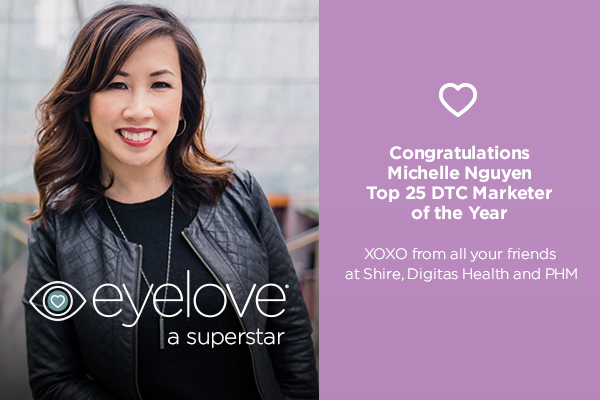
michelle digital ad_rev

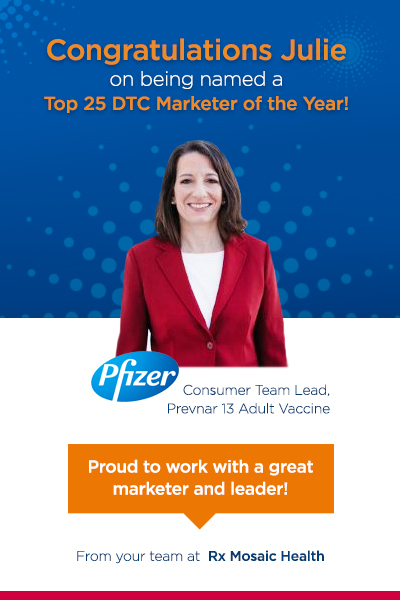
Julie Post Congratulations

DTC Perspectives, the leading forum for direct-to-consumer (DTC) advertising thought leaders names its 16th Annual list of the “Top 25 DTC Marketers of the Year.”

This year’s class will be honored during a joint ceremony dinner recognizing the 2017 Top 25 DTC Marketers and Hall of Fame class on the evening of April 5 sponsored by Outcome Health, formerly ContextMedia:Health, at the 2017 DTC National taking place in Boston. It includes representatives from more than 15 different manufacturing companies, with each marketer championing both the interests of the patient and brand.

“On behalf of the Outcome Health team, I am honored to congratulate the 2017 Top 25 DTC Marketers of the Year! These talented individuals continue to embrace technology and drive innovation to enhance how patients positively experience and interact with brands. We look forward to celebrating their achievements and impact on patient marketing at the upcoming DTC National Conference,” says Ashik Desai, EVP of Business Growth and Analytics at Outcome Health.

The Top 25 DTC Marketers of the Year for 2017 are…

  • Don Apruzzese, Consumer Lead, Neuroscience Franchise, Shire Pharmaceuticals
  • Lisa Blizzard, Director, Entresto Consumer Marketing, Novartis Pharmaceuticals Corporation
  • Lisa R. Chengary, Manager, Digital, Customer Engagement and Marketing Innovation, Takeda Pharmaceuticals
  • Ajaya Das, Director, Head of Marketing, Teva Women's Health, Teva Pharmaceuticals
  • Mary Eldridge, Consumer Lead, Respiratory Biologics, NUCALA, GSK
  • Elizabeth Fung, Executive Director, Linzess, Allergan
  • Dana Gaumond, Associate Director, Merck

Congratulations, Dana! From:

Unified, Powered by Omnicom


  • Sameer Goregaoker, Marketing Director, Oncology Multi-Channel Customer Engagement, Amgen
  • Keith Hopps, Director, CNS Marketing, Takeda Pharmaceuticals
  • Michael LaMotta, Director, Trade Strategy, Novo Nordisk Inc.
  • Kayte Lock, Senior Brand Manager, U.S. XELJANZ®/XELJANZ XR®, Pfizer Inc
  • Jason Marshall, Associate Director, Marketing, Stiolto Respimat, Boehringer Ingelheim
  • Brooke McCloy, Director, Marketing, Viagra, Pfizer Inc
  • Michael Moye, Director of Marketing, Cardiovascular (Xarelto), Janssen Pharmaceuticals
  • Michelle Nguyen, Consumer Marketing Lead, Shire Pharmaceuticals
  • Julie Post, Consumer Team Lead, Prevnar 13 Adult, US, Pfizer Inc

Congratulations, Julie! From:

RX_logo

  • Kelly Reilly, Associate Director, Digital, Immuno-Oncology, Bristol-Myers Squibb
  • Derek Rieder, Senior Marketing Manager, CREON, AbbVie, Inc.
  • Brent Rose, Senior Director, U.S. Product Marketing, Inflammation & Immunology, Celgene
  • Anna Sandler, Insulins Marketing Consumer Lead, Sanofi
  • Debra Sangiuliano, Director, Pfizer Inc
  • Frank Santaniello, Urology Franchise Marketing Leader, Astellas
  • Lina Shields, Consumer Marketing Director- Immunology, Eli Lilly and Company
  • Elizabeth Turcotte, Director, Patient Hub, Bristol-Myers Squibb
  • Lizelle Valdecañas, Marketing Leader, Cardiovascular, CVMD TA, AstraZeneca

“These elite pharmaceutical marketing professionals are this year’s top contributors to the advancement of patient outcomes via direct-to-consumer pharmaceutical education and marketing,” adds DTC Perspectives Chairman and CEO Robert Ehrlich. “We would like to recognize the faces behind prominent DTC campaigns, because their hard work and dedication to fostering the industry is often not recognized. The awardees were selected from many worthy candidates.”

Select honorees will also participate in a panel discussion on current DTC marketing issues at the DTC National Conference, held April 5-7 at Westin Copley Place.

Click here to register for the DTC National Conference or contact the DTC Perspectives office at 770-302-6273.

Celebrate with the Industry’s Best

Congratulate the Top 25 Marketers in-person and in our publications! DTC Perspectives offers reserved tables with seating for 10 at the Top 25/Hall of Fame and Advertising Awards ceremonies as well as congrats ads opportunities in our DTC Perspectives Magazine/DTC National Conference Guide, on our website, and in Email announcements. Click here to view awards packages and congratulate a Top Marketer/DTC Hall of Fame inductee today.

Deadline for print congrats ads: Friday, March 3, 2017

[button link=”https://www.cvent.com/events/2017-dtc-national-conference/registration-7921d0bd6c754def8e40c271f4d2f625.aspx” color=”red”]Purchase Congrats Ads and Reserve Dinner Tables[/button]

admin


February 3, 2017 0

This week many drug CEOs met with President Trump to discuss pricing and innovation. In just two weeks Mr. Trump has sat down with a number of business leaders to push domestic investment in job creation. He pushed the drug makers to build factories here and get control of drug prices.

In return Trump promised to promote speedy approvals at FDA following his early push across industries to reduce regulations hampering business growth. Based on drug stock prices after the meeting ended it seemed to go well. Mr. Trump wants to love drug companies but to continue that fond view he asks for lower prices and domestic job creation as part of the deal. He seemed to be willing to find ways to lower prices without a heavy handed price negotiation through Medicare. Mr. Trump is not surprisingly making industry uneasy while at the same time offering rewards for cooperation.

Bob Ehrlich
“I applaud PhRMA and Y&R for going boldly in their ad.”
-Bob Ehrlich

The drug companies know that having a public image that is suffering, with both parties in Congress willing to stick it to them on price, and a President saying they get away with murder is a risky environment. So in that context the drug lobby premiered a new television campaign pushing its commitment to drug research. The ad was created by Y&R New York.

The new GoBoldly spot is very different from past PhRMA efforts. Traditionally ads plugging drug makers were kind of clichéd with stories about caring people working tirelessly to save lives. It is not that the ads were portraying the wrong message, just that they were executed in an ineffective way. The new spot also shows researchers hard at work but does it in an attention getting manner.

The ad uses the well known Dylan Thomas poem “Do Not Go Gentle into that Good Night” and adapts it to a drug research context. Read by a British voice over actor the spot has serious stopping power. It shows researchers not accepting failure as they go boldly to find cures. It is impossible to ignore when it comes on. What is very different is that the audio voice over is only the poem, while all the drug research copy is on the supers. It is a very dramatic portrayal.

Whether it will change attitudes about drug companies is hard to predict but it will get awareness. A great television ad is a start but hopefully this campaign is only the first part of a prolonged consumer effort to change attitudes. A print, radio, and web campaign is also in the mix.

That media and PR effort should address price. Americans already believe drug makers invent needed cures. This type of ad is going to get noticed but also prompt the skeptical query about price. When the President says drug makers must lower price, and Congress, consumerists, insurers, and providers agree, even a great ad is only just a start.

I applaud PhRMA and Y&R for going boldly in their ad execution. Shunning the usual voice over announcer saying how dedicated drug companies are and instead trying a breakthrough creative approach is a nice change. The drug makers have some explaining to do beyond their efforts to find cures. Telling Americans that great research costs a lot is a hard sell given Canadians and Europeans get the benefits at prices 30-50% less.

Trump may be on to something that perhaps creating thousands of new manufacturing jobs might help make higher prices a bit more palatable. I think drug makers know that Trump and other constituencies are looking for more than the usual explanations on how research is costly. Trump understands that cutting development costs in terms of approval times means more sales under patent protection and more room to deal on price. I sense that he will be dogged in ensuring that Americans see a tangible price benefit to his regulation easing.

Trump knows the art of cajoling. While many see him as bullying I think CEOs know he is just posturing to get a good deal.

Bob Ehrlich


January 27, 2017 0

Trying to be objective about Obamacare seems to be as difficult as with every other major policy issue these days. The newspaper headlines from the media are saying thousands of people will die if Obamacare is repealed. The Washington Post in a January 23 story cited estimates by medical professors who estimate the number at 44,000 annually. Bernie Sanders said 36,000 will die. These numbers assume no replacement plan which no Republican is advocating.

Bob Ehrlich
“The jury is out on whether we are better off.”
-Bob Ehrlich

I looked at some statistics to see whether Obamacare is as good or as bad as critics say. First Obamacare definitely added millions of people to the insured category. That is a fact not disputed. The HHS says 20 million people have been added to the insured rolls since 2010. About 12 million are in the exchanges and the rest are covered by Medicaid expansion. We also see several million children under 26 kept on their parents’ plan.

The issue to debate is did we add enrollees cost effectively. Are we all paying more to insure these 20 million than we should? Republicans say there are better ways to get people coverage. Did costs rise? Yes, they did for Obamacare enrollees and those covered by employers as well. In 2008 according to the Kaiser Family Foundation the average family plan cost employers $12,680 with $3,354 borne by employees. In 2016 costs were $18,142 with employees picking up $5,277. Supporters of Obamacare say costs were rising before it was implemented so this rise is not from the Obamacare provisions.

That is not the only problem. Deductibles have risen dramatically. In 2008, only 16% of employer plans had deductibles of $1,000 or more. In 2016, 51% of employees covered had $1,000 or more in deductibles. On the Obamacare exchanges the situation is much worse. Deductibles vary by type of plan chosen with more expensive premiums providing lower deductibles. The popular Bronze plans average more than $5,000 in deductibles. It is probably fair to attribute these huge deductibles partially to the coverage mandates.

We are also seeing many state exchanges showing huge increases in premiums with the average being 15% in 2016. Many families are paying well over $10,000 in premiums and deductibles. For them Obamacare essentially just covers them for a catastrophic illness. It is true they get a free prevention exam and some other free diagnostic tests but that is not much for their $10,000.

Supporters of Obamacare say having 20 million more people covered is a societal benefit worth paying for by all of us. Maybe it is, but just maybe we are all paying more than we need to if we had a different approach. The Republicans say they can provide better coverage at lower cost. They think free market insurance competition and giving the states more control over budgets can lower cost. They also think that more consumer responsibility for spending decisions will make patients more aware of cost and provide pushback on healthcare prices.

What is very clear is that Mr. Obama’s promise of lowering premiums for every family was not achieved. In 2008 he promised the average family will save up to $2,500 a year. Many markets now only have one insurer willing to provide coverage. Clearly this reduced competition is not helping lower premium rates. While more people are covered today than pre-Obamacare, the jury is out on whether we are better off. That depends on who you are. Anyone with a pre-existing condition is likely better off. Those of us who had employer coverage before are likely not better off today because we are subsidizing insurance companies mandated to cover pre-existing conditions.

Democrats find many examples of the poor or people previously denied coverage who now have access to care. They tout these as reasons to keep Obamacare. Analyzing success, however, must also include the effects on everyone who is asked to pay for it. My guess is we have better alternatives that will provide coverage for less. That does not mean all people currently insured and subsidized will be better off under a new Republican plan. What is clear from Obamacare is insuring people already sick is very expensive and that healthy people do not sign up in high enough numbers to subsidize those folks.

As a compassionate society, we should not let people lose their life savings or get no care because they get sick. That does not mean we cannot create a much more targeted and affordable plan to do that. The proof will be in the details from the replacement plans proposed. Level headed analysis rather than hyperbole is what is needed in Congress but we do not seem to be in the political mood to do that. Keeping an unaffordable plan is not the answer the American people are seeking.

Bob Ehrlich


January 26, 2017 0

DTC will be much more important in the new health care era post Obamacare. This is not just for drug companies but for all health care goods and services. The Trumpcare plan will be shifting more decisions on health care to consumers based on free market competition. Americans will be given greater control over spending a pot of dollars allocated to them by government. Although we have not seen a final replacement plan we do know it will likely contain health savings accounts, tax credits, wider choices for insurance coverage, and some minimum affordable coverage for people with pre-existing conditions.

Bob Ehrlich
“A free market will rely even more on advertising…”
-Bob Ehrlich

Americans will be encouraged to shop for health care like they do for all other products they buy. Yes I know the critics of free markets say health care decisions are different from other types of products and more important than choosing a dishwasher or cell phone. What consumers will do is give health care decisions much more consideration. Consumers probably spend a lot more time shopping for a car than for a heart surgeon. To evaluate health care decisions they will need transparency on prices and good information on pros and cons of their choices.

Health care information on products and services will become a boom industry. Rating services will spring up that tell consumers what health care services should cost and provide reviews on providers price/value. A free market will rely even more on advertising to pitch and justify services and this is where DTC will grow. We already have hospitals and physician advertising to consumers. What will change is a much more explicit price/value oriented advertising approach. As consumers are given more control over their limited health care spending, they will need more convincing on where to spend those scarce funds.

In today’s someone else pays system, we do not usually question the need for what our doctor recommends. We do not ask if that CAT Scan is essential because we never see the full bill. We do not ask for generics if a new branded drug is covered. We do not push back if the dermatologist asks to take a piece of our skin to biopsy as long as it is covered. Once we have the limited pot of dollars under our control we will be much more involved in making the go/no go decision on treatment. We all know doctors err on the side of over treatment because they do not want to be sued. That defensive medicine will be reduced as we pay more of the bill.

The critics of consumer controlled free market health say people will avoid important tests and treatments to save money. This may in fact be a problem and under treatment could be an issue with consumer controlled limited dollar plans. What we hope for is that good health care information will tell consumers what are the best investments to keep them healthy. In other words which tests/services are critical and which are just nice to do. Like it or not all health care decisions are a cost/benefit calculation. We do not, as a society have unlimited resources. Trumpcare will place more burdens on us to decide how and how much to spend on health care.

One would hope that essential health care services become more easily available at lower prices. Competition should do that. We can expect more chain medicine as big providers will emerge who can use volume to offer lower priced services. That means many smaller, inefficient providers will be forced out. Clearly when price/value becomes the main concern of consumers the market will change significantly. Advertising will become critical to tell that price/value story as consumers will push back on providers to justify the recommended service or product.

Bob Ehrlich


January 19, 2017 0

In what might be the most puzzling FDA DTC study proposed to date, the agency wants to see if consumers can recognize deceptive claims in DTC ads. In this study FDA wants to create mock ads with deceptive claims to see if consumers recognize those false claims and evaluate how that affects their perceptions of and requests for the drug. FDA is concerned consumers might ask their doctor more often to prescribe a drug hyped with deceptive ad claims.

Bob Ehrlich
“I have problems with the proposed study.”
-Bob Ehrlich

I have problems with this proposed study on many fronts. First, how are consumers supposed to know what is in the approved label to decide what is deceptive? In the study proposal apparently the plan is to plant false claims on a mock website and see if consumers can spot them. So FDA will have consumers play detective like those games where you see two photographs slightly altered to spot the changes? I just do not get the method here or how consumers should know what is an approved, accurate claim. Does FDA want consumers to be the vanguard of regulation and report claims they think are deceptive? Is FDA going to staff a hotline to receive consumer complaints?

Second, the consumer relies on FDA to prevent deception. Drug ads are already the most scrutinized ads in America. Most ads are pre-cleared well before they run. Consumers expect the claims in an ad to be vetted by FDA so what is the study goal in purposely putting in deceptive claims to see how misled is the consumer? I don’t understand an agency testing what would be the result of their own failure to effectively regulate DTC.

Third, what possible help could this study provide in future promotional guidances? False claims are already prohibited. Each branded ad must meet strict FDA criteria for fair balance. A study that proves consumers can be deceived and might be unable to know they are being deceived proves what? Is FDA trying to prove consumers who do not know what is in the approved label can be easily fooled by rogue drug companies? This study might be more appropriate for supplements or other non Rx drug health products that often make unproven efficacy claims in their ads. FDA seems to be asking a question they already know the answer to. If a drug makes deceptive efficacy claims, it is going to be more appealing to consumers. Hello, my new drug cures cancer. You interested?

Fourth, just by doing this study FDA is promoting a negative attitude against DTC. To study purposeful deception is to imply there is a broad history and likelihood that drug companies will engage in false ad making. In 20 years of television DTC ads, there are a only handful of ads that overstated efficacy. Those ads were withdrawn and in a few cases corrective ads were required. In other words why study deception when it almost never happens in DTC ads? Most warning letters are over subjective elements like distracting music or scenes, not over false claims. FDA already has procedures to punish deceptive ads. Is this deeper understanding using mock deceptive ads going to make FDA a better regulator?

Consumers deserve accurate and balanced DTC ads. Any study which helps improve those objectives are welcome. In this case, measuring how well consumers spot false ads does not, in my view, add to better ad development or regulatory guidance.

Bob Ehrlich


January 16, 2017 0

Pharmaceutical patient apps are a hot topic among brand teams these days. They hold great promise for a brand across the patient journey, from supporting a dialog with physicians to setting treatment expectations to supporting disease or lifestyle management to providing support to maximize adherence.

Yet, for all its promise, many brand teams have been disappointed with the results of their patient apps, measured in terms of downloads (scale), repeat usage (engagement) and business impact. I’ve witnessed a number of factors that drive this. Among them:

  • Failing to identify a user real need
  • Failing to differentiate from competitive apps
  • Insufficient focus on recruitment
  • Failing to integrate the app into a wider patient support ecosystem
  • Failing to maintain the app

These are fundamentally product design and management challenges and they usually result from a failure to plan adequately in advance.

If you are thinking about an app for your band, first remember this: 80-90% of apps are used once and then deleted, according to a study by Compuware. Then answer these seven deceptively simple questions. It can mean the difference between success and failure.514136851

  1. Who are the patient needs we are trying to serve?

Sadly, most pharma apps exist to serve a business purpose. If you are planning an app, make sure you have defined a clear and pressing user need. Market research is a must and ethnography is a great tool to help you discover real pain points in a patient’s experience and in their use of your product.

  1. How will we differentiate?

In the app universe, pharma not only competes against other drug manufacturers but also digital health start-ups and publishers. If the need you seek to fill is already being satisfied, think twice about duplicating it, unless you have a clear plan to provide a significant leap in utility.

  1. Do we understand the drivers of utility?

Most successful apps do a small number of things exceptionally well. Involve patients in the design process to understand which features will give you the biggest bang for the buck. Avoid feature creep.

  1. Do we understand how the app links to our wider support ecosystem?

The best apps out there are a single node of a broader digital ecosystem. All of the pieces fit together. For example, the app is linked to the nurse call center, which is linked to the patient support site. You will avoid the “silo” trap if you set out to design an integrated patient experience, not an app.

  1. How will we drive enrollment?

A scan through pharma app download statistics will reveal a sad truth: most are only seen by a very small percentage of patient populations. To avoid this fate, you need a clear plan to drive recruitment. There are many options here ranging from search, to social network ads, to rep-pull through.

  1. Should we build or partner/buy?

Pharma companies are great at partnering when it comes to licensing medicines, but for some reason when it comes to apps, the tendency is to build versus partner. As a result, a lot of money is wasted creating functionality that already exists or could be built faster, cheaper, and better with a start-up or health publishing partner. Smart Patient and Mango Health are two examples of companies partnering well with pharma.

  1. How do we create a bridge to business value?

The best apps put the user first and provide a compelling, easy-to-use differentiated experience. But they also have a commercial strategy. Whatever your app’s purpose, think creatively about how to drive the behavioral result you desire.  Define this “conversion event” and built it into the user experience.

Happy apping!


Republished with permission. Click here to read the original posting on MediaPost.

Gregg Fisher


January 14, 2017 0

Over the past 25 years, PatientPoint has established themselves as a leader of patient and physician engagement solutions at the point of care. The company closed out 2016 on a high, with the launch of a new mobile app, PatientPoint 360, as well as the acquisition of MedCenterDisplay. This week, they kept the momentum rolling with the announcement of their new collaboration with the American Heart Association. With a network of over 290,000 healthcare providers, PatientPoint will be able to share the AHA’s public service announcements and educational content on a large scale, further extending the mission to build heart-healthier lives. Senior Vice President of content and creative for PatientPoint, Katie Merz, says that “the collaboration will provide patients in our growing cardiology networkaha access to a powerful resource to help them find the tips, tools—and therapies—to better care for their heart”.

To learn more, visit www.patientpoint.com

Lily Stauffer


January 6, 2017 0

It is always fun to hear pundits make predictions. Most of the time they are wrong but we eagerly watch experts tell us who will win elections, how much stocks will rise, what the price of oil will be, and which film will win best picture. We have a media that exists to debate these issues 24/7.

Bob Ehrlich
“We have not had such uncertainty since 2009.”
-Bob Ehrlich

So why should I miss out on the prediction game. I really have no way of knowing what will happen in health care, DTC spending or regulation. I do, however, have an informed opinion on where we might end up. So, for what it is worth here goes for 2017.

  1. DTC will continue to thrive no matter what the politicians decry about greedy drug companies. We have the first amendment and DTC generally works well as a promotional strategy. True, Congress knows the drug industry is an easy target. They also know that drug marketing employs lots of people in their districts. So they will huff and puff but in the end not adopt any rules to make drug ads harder to execute.
  2. Trump is a real wild card as far as drug pricing actions. He may threaten drug companies with Medicare price negotiation and actually mean it. On the other hand Trump knows that forcing prices down could hurt jobs and innovation. More likely he will arm twist drug CEOs to pricing self restraint and then tweet his victories.
  3. Obamacare will be drastically altered to be more free market. Mandated coverage will be eliminated and consumers will have more choices what, where and how to buy insurance. Republicans will replace it slowly, however, and be very cautious throwing currently covered Americans off the insured rolls. Free market policies will shift the burden of health care decisions more to consumers and this has numerous marketing implications for drug companies. Price/value will be something drug advertisers must consider in their messaging.
  4. The FDA will get an overhaul to be faster decision makers on new drug approval and hopefully that will include the glacial moving OPDP. Nothing against the generally nice folks who work there but please try doing research that actually gets done in a timely fashion. Also, the social media train left years ago but OPDP cannot seem to accept consumers know how to easily one click to see warnings and risks.
  5. DTC media mix will continue its evolution towards social media and point of care, but nothing indicates that mass media will decline. Drug companies have better mass media targeting tools and that means getting more effectiveness. In fact more specialty brands are using television because the mass awareness, although inefficient, still brings in enough new customers that justify the expense.
  6. Media consolidation is happening in new media. There are starting to be mergers and acquisitions that will eliminate a whole lot of smaller players. Having bigger companies will make it easier to buy larger physician and patient coverage in Point of Care and Internet media. Drug companies like to one stop shop so expect more dollars allocated the easier it gets to buy large scale.
  7. Expect more drug company corporate media and DTC advertising efforts to justify drug prices. There are valid reasons for high prices in most cases, but Americans are perplexed why they pay more than other developed countries. It is a very tough sell but Americans are demanding to know what the premium price is getting them.

2017 will be an exciting year for health care marketers as change always breeds risks and opportunities. We have not had such uncertainty since 2009 when Obamacare was formulated.

Bob Ehrlich


December 16, 2016 0

The arbitrary reviewers at FDA have decided that Otezla and Toujeo have music that is disturbing the peace. They have knocked on the walls of Celgene and Sanofi by issuing letters saying their television ads violate the law. How do they know they broke the law?

The beauty of the FDA system is they decide what is distracting. They don’t need to have any objective consumer based evidence of distracting music or rapid scene cuts. I have no doubt these ads pump up the music and fun. The problem, for all of us doing DTC is these two ads are fairly routine for DTC and similar ones have been on air for years. The letters are surprising and must represent some internal decision to get tough. Maybe they are being criticized for lax enforcement because the number of warning letters and untitled letters have come down.

Bob Ehrlich
“I do not think much of FDA’s evaluative process.”
-Bob Ehrlich

So, they decide to force the drug maker and agency to pull the ad, spend a small fortune re-shooting or re-editing. Judge, jury and executioner. Nice system. Evidence, they don’t need no stinking evidence.

I have seen these ads for months and never once did I think, wow, these ads are distracting and must violate a host of FDA regulations. I guess any ad with music and happy people is now under the scrutiny of FDA reviewers, who apparently have decided to crack down on happy people dancing. I know some in Congress want to go after happy DTC people having sex, but I digress.

As you can tell I do not think much of FDA’s evaluative process. These type of ads have been in vogue for years for many brands. So how slow and low must the music be, how slow the cuts from scene to scene, how long must the supers be? Is dancing limited to one actor, two? None of us know because FDA can decide what is a violation. I am sure Celgene and Sanofi can discuss it with FDA before the sentence is carried out. They have as much chance of a reversal as appealing to a North Korean court after insulting the great leader.

FDA should be forced to have real quantitative research data that supports what they say in their letters. Maybe at the very least a panel of consumers can be brought in to screen ads FDA thinks are problematic. I urge that some system of evaluation be added that can be more objective than a single reviewer. I know the reviewers believe they are acting fairly. I am sure they are bright, hard working folks just trying to do right. But they are arbitrary and inconsistent. That makes it difficult for drug makers to predict how they might react to an ad that is upbeat. For drug makers, what they need is consistency just like we want in an umpire or referee.

Maybe this is FDA getting their last regulatory licks in before the new Trump sheriff comes to town. More letters can be expected if this is how they will approach DTC ad review. Even after 20 years in DTC, the FDA can still surprise me.

Bob Ehrlich