Latest News


February 23, 2017 0

movember foundationOn February 17th, the Movember Foundation went beyond the moustache by expanding their promotional efforts through PatientPoint. With prostate cancer now the second most common form of cancer seen in men in the U.S., the two organizations teamed up to spread awareness and inspire healthy action between men and their healthcare professionals. According to Paul Villanti, the executive director of the Movember Foundation, “too many men don’t talk about their health, don’t take action, and as a result, they die too young from diseases that are often treatable”. PatientPoint programs impact half a billion patient and caregiver visits each year –this kind of reach will be huge for Movember Foundation and help them push towards their goal: to stop men dying too young.

To learn more about Movember, click here, or to read the news release, click here.

Lily Stauffer


February 17, 2017 0

I was shocked to see media stories saying DTC may expand to cover off label use. What! This erroneous idea came from an FDA open meeting held 11/16 to discuss off label use based on court cases allowing drug companies the right to discuss them. FDA has been under pressure on first amendment grounds to liberalize their restrictions on drug companies educating doctors and other learned players on off label studies.

Bob Ehrlich
“FDA will take years to study the issue.”
-Bob Ehrlich

As far as I know no one at FDA is seriously thinking of allowing drug companies to advertise off label use to the public through DTC. I know we are in an era of fake news but seriously folks. FDA goes nuts when the background music is too loud on DTC ads. Does anyone think they will allow drug companies to tout off label uses to consumers? No, they will not. Not even under free marketer Trump

The whole debate over off label is because courts have ruled drug companies can use commercial free speech to discuss studies reflecting off label uses. FDA is trying to figure out how to deal with the first amendment in regulating such uses. They have been strictly using approved label claims as the standard but drug companies want the right to tell the medical world about legitimate off label studies.

I do not think drug companies expect to carry this free speech argument to DTC. All they want is to be able to do is discuss such uses with medical professionals who would want to know that information. Can a detail rep tell a doctor about a study involving off label use? Can a drug company tout such off label uses in discussions with stock analysts? FDA has been quick to pounce on drug companies promoting off label studies to anyone. They fear misinterpretation and incorrect use. They might be justified in their concerns but also need to allow business speech that is fact based even if not yet approved in the label.

The lay press thinks that FDA might open the floodgates of off label use in DTC. A publication as reputable as Consumer Reports had a story 11/9/16 titled “FDA Considers Allowing Drug Ads for Unapproved Treatments.” I am not sure why Consumer Reports made the leap from possibly loosening the regulations for discussions with doctors all the way to DTC. That story seemed to be picked up by many news organizations who said drug ads may increase because of off label uses.

I think the FDA will take years to study this issue and not do more than the courts push them to do. They are just figuring out how drug companies can use the Internet about 20 years late. They are worried consumers will get confused figuring out how to click on the fair balance. So, I do not think off label use is on their list of DTC to do projects, not for a decade or two.

Bob Ehrlich


February 16, 2017 0

Should Pharma Site Metadata Play by the Same Rules as Paid Search Ads?

This is the second entry in the series about “promotional peccadilloes” available on Convergence Point Media's Insights blog – topics that often trigger a perceived conflict between good regulatory compliance and effective marketing, and our perspectives on best practices to address them. 

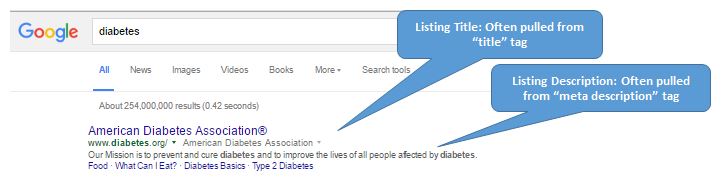
MarcBenjamin-ArtworkThe SERP (Search Engine Results Page) has become the primary gateway for patients seeking health information. As people research a condition or its treatment options, search results often serve as a brand’s first impression, playing a critical role in the split-second decision to click and engage, or move on to other results. While organic search results are controlled by proprietary search engine algorithms, site owners are responsible for the meta tags placed on their pages.

A brand’s decisions about SEO meta tags can have very real implications on organic (non-paid) site traffic and engagement, so hitting the mark on both compliance and effectiveness is a significant competitive advantage. To be blunt, it’s easy to be compliant by erring on the side of extreme caution – but the concerns of both marketers and reviewers are best address holistically, giving rise to informed decision-making with sensible safeguards resulting in better digital outcomes. SEO metadata is a shining example of how this can play out.

A little refresher may help put this in perspective. Meta tags play an important role in a website’s discoverability via organic search results – or, as described by Google, a “way for webmasters to provide search engines with information about their sites”.  They are strings of HTML code that provide descriptive information about the content of the web pages they are placed on, meant to help search engine’s automated crawlers accurately formulate relevant search results and appropriate rankings. Here, we will focus on the two types of meta tags found on web pages that are available to search engine algorithms in generating organic listings.

  • Title Tag:
    • Function: accurately and concisely describes the page’s thematic topic
    • Appears in page source code as: <title>Page title here</title>
  • Meta Description Tag:
    • Function: provides a short description of the page’s content
    • Appears in page source code as: <meta name=“description” content=”Page description here” />

While the organic listings users see on the SERP may include the provided meta tags, Google's generation of organic results “is completely automated and takes into account both the content of a page as well as references to it that appear on the web.” Importantly, even if site owners omit meta descriptions altogether, the engines crawl the page content and other sources to determine what will be displayed in the search result. With respect to best practices for their intended use, Google states that “the goal of the snippet and title is to best represent and describe each result and explain how it relates to the user's query. The more information you give us, the better your search result snippet can be.”

MarcBenjamin-Artwork1

Since title and description tags are often pulled by the engine crawlers into the results users see on the SERP, this sets up what may be perceived by brands as a conflict between best practice website development and promotional compliance. The simple question we address today is “should branded pharma web sites restrict their meta data to conform to compliance standards used for paid search ads?”

State of the industry – Who’s doing what?

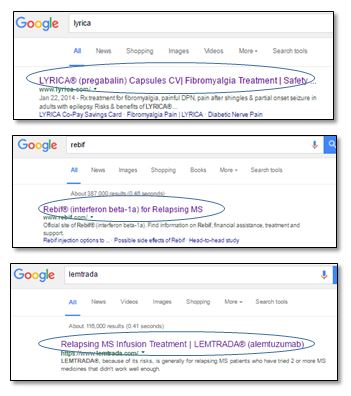
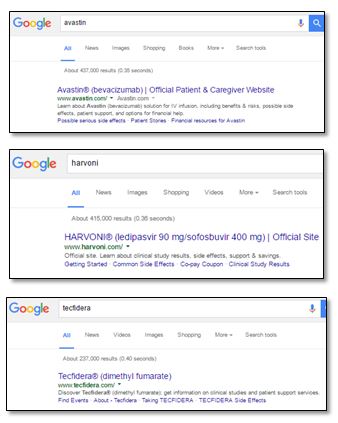
Within the Rx pharmaceutical industry, where promotional practices are often consistent across major manufacturers, brands appear split into two groups with respect to their approach to website title and description tags.  One group conforms with the intended purpose of the metadata elements, using the available space to fully summarize the site or page content for the benefit of the search engine algorithms, typically including prominent naming of the disease state the product is approved to treat. Others, however, restrict meta tags on branded sites to conform with the “reminder and  “reminder-like” ad format for compliant branded paid search ads (as defined by Dale Cooke on the Regulatory Rx Blog). These include the brand and generic names and may contain dosage form, quantitative ingredient statements and other descriptive information provided they make “no representation or suggestion” about the product use.

Examples of brands not restricting metadata:

MarcBenjamin-Artwork2

Examples of brands restricting metadata (using “reminder” or “reminder-like” format):

MarcBenjamin-Artwork3

Below we summarize key considerations with respect to both common approaches:

Reasons to restrict metadata:

  • Applying the principles of the “reminder format” essentially treats meta data as equivalent to direct brand communications and increases the probability that an organic search result will be constructed by the search engine without implying a claim
  • This is arguably the most conservative and risk-averse approach from a regulatory perspective as it removes fair balance from the equation altogether

Reasons not to restrict metadata:

  • Irrespective of the presence of meta data, search engine algorithms ultimately determine what shows as copy in organic listings; website owners do not.
  • There has yet to be any specific direction from FDA on metadata and no rules requiring their adherence to the “reminder” format in place for paid search ads – specifically:
    • In sending 14 enforcement letters pertaining to paid search (SEM) campaigns to pharmaceutical companies in 2009, FDA weighed in forcefully against the practice of limited space ad copy making brand claims without meeting all of the requirements for a full product promotion. The absence of any corresponding direction explicitly addressing metadata and organic listings in 2009 and for the 7 years since suggests that meta data is seen in a different light.
    • The industry has taken the cue, with many pharma brands using meta titles and descriptions that include brand names and claims that correspond with the contents of their respective web pages, much like the algorithms themselves might generate in the absence of site-provided metadata.
  • In the absence of formal rules preventing their use, fully transparent meta data offers search engines more accurate and transparent descriptions of a drug than can be deduced by an algorithm. The result is an arguably superior user experience for patients and HCPs, as metadata can more accurately represent page content. The core goal of search engines is to communicate to the searcher the contents of the indexed pages, and titles and descriptions help the engines maximize accuracy to users when includes condition information. As we argued in our previous post in defense of controversial paid search keywords, given the abundance of incomplete and inaccurate information about drugs online, it serves the public interest for consumers to have unfettered visibility to the drug information provided by an FDA-regulated information source. Uncensored meta data makes that possible.

As implied above, a third option that pharma website owners have is to omit title and/or description tags altogether, leaving search engines to select content from the indexed webpage that it deems most relevant for inclusion in the organic result. We do not recommend this option as it introduces a greater degree of uncertainty to the process, leaving it entirely to the engines as to how to describe the page, site and/or product.

When a brand chooses not to restrict its meta tag content to conform with the “reminder ad” format, we recommend applying best practice guidelines:

  • In meta descriptions, include language encouraging searchers to read the brand’s important safety/risk info, and ensure that the full ISI is included on the linked page
  • Use copy consistent with drug’s approved indication and avoid being misleading
  • Include brand name and generic name
  • Indicate the intended target audience (Patient/HCP/Caregivers)

Branded Website Meta tags – The Good, the Conservative and the Ugly

Example condition: Pediatric Relapsing MS

Homepage Meta Title and Description Tag

Thoughts

Good Brand® (generic name) for Pediatric Relapsing MS

Learn about Brand as a treatment option for pediatric relapsing MS including risks and side effects information for patients & caregivers.

  • Includes brand name and generic name
  • Calls for review of safety info
  • Addresses the target audience
  • Is relevant to the approved indication
Conservative Brand® (generic name) – Official HCP Site

Learn about Brand, side effects and financial assistance info for your patients.

  • Makes no claims; “reminder” format
  • Provides restricted info about the site they are going to visit
Ugly Brand® (generic name) for MS Cure

Learn about the best treatment for MS cure.

  • Does not attempt to encourage review of safety info
  • Does not addresses the target audience
  • Broadens the approved indication to include all forms of MS

This article has been reposted with permission from Convergence Point Media. Click here to read the original posting.


Marc Benjamin


February 14, 2017 0

160420-dtc-1087

The leading forum for direct-to-consumer (DTC) advertising thought leaders honors a dynamic group of pharmaceutical companies and brands at the much-anticipated DTC National Advertising Awards. The awards are part of the 17th Annual DTC National Conference to be held April 5-7 in Boston. Sponsored by Health Monitor Network, the 2017 Advertising Awards will showcase the best marketing and advertising across 17 categories.

“The DTC National is exciting each year for us as a celebration of the creativity and effectiveness of DTC consumer promotion,” says Ken Freirich, President of Health Monitor Network. “As an entrepreneurial company developing creative solutions to facilitate patient and HCP dialogue, we are pleased to sponsor the awards and to recognize the many successes in the marketplace.”

The 2017 Ad Awards showcase exemplary work spanning multiple media and strategic categories. During the Advertising Awards Dinner held on April 6, Gold, Silver, and Bronze winners will be announced for all 17 categories. Be there in person to salute the winners or receive recognition for a job well done.

“We are proud to celebrate our 16th Annual DTC Ad Awards ceremony,” says Bob Ehrlich, CEO of DTC Perspectives. “The inclusion of new categories and more awards over the years is a reflection of the success of the industry as a whole. Congratulations to all of the finalists and we look forward to recognize innovation for years to come.”

To register for the DTC National Conference, order tickets to the Ad Awards dinner only, for more details about the event or Advertising Awards, visit www.dtc-national.com or contact the DTC Perspectives office at 770-302-6273.

[button link=”https://www.dtcperspectives.com/dtcn/2017-ad-award-finalists” color=”grey”]View Ad Award Finalists[/button]

[button link=”http://dtcperspectives.cvent.com/events/2017-dtc-national-conference/custom-17-7921d0bd6c754def8e40c271f4d2f625.aspx” color=”red”]Register[/button]

Celebrate with the Industry’s Best

DTC Perspectives offers reserved tables with seating for 10 at the DTC National Advertising Awards Dinner or the Top 25/Hall of Fame Awards Dinner. To reserve a table, click here.

[button link=”https://www.cvent.com/events/2017-dtc-national-conference/registration-7921d0bd6c754def8e40c271f4d2f625.aspx” color=”red”]Reserve Dinner Tables[/button]

admin

A_visually_striking_featured_image_for_an_article_.jpg

February 10, 2017 0

Merck’s cancer drug Keytruda recently began its DTC campaign competing with Bristol Myers’ Opdivo. What is significant is that highly targeted drug categories continue to invest heavily in DTC. Keytruda is a biologic injection that has indications for non small cell lung cancer, advanced melanoma and head and neck cancer.

Bob Ehrlich
“Keytruda has done an excellent job in its DTC ad.”
-Bob Ehrlich

The market is small by size compared to mega categories like diabetes and cholesterol where sufferers are in the tens of millions. Lung cancer cases number about 200,000 newly diagnosed annually. Of course, when the treatment price is around $100,000 per year for biologic lung cancer treatment versus less than a thousand for cholesterol drugs; the DTC payback is certainly achievable.

Roughly the numbers show a $50 million ad campaign for Opdivo and Keytruda need only gain 500 new patients from DTC to break even on a revenue basis. While consumers are the DTC apparent target, these ads also reach oncologists. Once an oncologist knows patients are seeing the DTC and will ask about the drugs, it clearly provides the motivation to consider using them.

The Keytruda ad is very different from Opdivo. While Opdivo used a headline dramatic announcement approach, Keytruda chose an individual patient story. Using an actor portrayal Keytruda showed a 60ish age woman named Sharon telling her story in a tv production studio. Sharon says she learned her type of lung cancer could be treated with an alternative to chemo. She tells how she was given only months to live but a year later after treatment she is still there with her family.

The commercial is filmed in black and white which adds to the seriousness of the presentation. Sharon’s story in this 90 second ad is told very well. It is very informative and understandable using Sharon and supers emphasizing the key benefits. What is interesting is that they are showing Sharon in the production studio both telling her story and in the makeup room preparing to be filmed. Her family is also at the studio watching her being filmed telling her success story.

The sell portion of the ad is about 30 seconds with fair balance risks and warnings in the last minute. Clearly the ad is technical in terms of disclaimers about who can take the drug and one wonders if patients who have non small cell cancer are aware of their biomarkers and gene types mentioned in the ad.

Given the high prices for treatment stock analysts see Keytruda generating revenue in the billions. A DTC campaign costing $50-100 million for a drug bringing in billions is a small risk for Merck. Opdivo had been criticized by some doctors for advertising to patients in an area best left for oncologists. This is a fair question but advertising breakthrough therapies does help potential patients become aware of their options. It also puts pressure on insurance companies to cover the large expense.

Keytruda has done an excellent job in its DTC ad. This campaign will get attention and is very different in executional style from Opdivo, an ad I also think is very good. The broader concern is whether advertising $100,000 drugs to consumers causes Congress to look more critically at both drug prices and DTC ads. While individual patients get extra months and in some cases years longer to live, government payers and insurance companies are paying a lot for that life extension. While no one wants to put a price on those months, unfortunately it is a calculation needed to be considered by policy makers.

Bob Ehrlich


February 7, 2017 0

Dana Gaumond Top 25 DTC Marketer

michelle digital ad_rev

Julie Post Congratulations

DTC Perspectives, the leading forum for direct-to-consumer (DTC) advertising thought leaders names its 16th Annual list of the “Top 25 DTC Marketers of the Year.”

This year’s class will be honored during a joint ceremony dinner recognizing the 2017 Top 25 DTC Marketers and Hall of Fame class on the evening of April 5 sponsored by Outcome Health, formerly ContextMedia:Health, at the 2017 DTC National taking place in Boston. It includes representatives from more than 15 different manufacturing companies, with each marketer championing both the interests of the patient and brand.

“On behalf of the Outcome Health team, I am honored to congratulate the 2017 Top 25 DTC Marketers of the Year! These talented individuals continue to embrace technology and drive innovation to enhance how patients positively experience and interact with brands. We look forward to celebrating their achievements and impact on patient marketing at the upcoming DTC National Conference,” says Ashik Desai, EVP of Business Growth and Analytics at Outcome Health.

The Top 25 DTC Marketers of the Year for 2017 are…

  • Don Apruzzese, Consumer Lead, Neuroscience Franchise, Shire Pharmaceuticals
  • Lisa Blizzard, Director, Entresto Consumer Marketing, Novartis Pharmaceuticals Corporation
  • Lisa R. Chengary, Manager, Digital, Customer Engagement and Marketing Innovation, Takeda Pharmaceuticals
  • Ajaya Das, Director, Head of Marketing, Teva Women's Health, Teva Pharmaceuticals
  • Mary Eldridge, Consumer Lead, Respiratory Biologics, NUCALA, GSK
  • Elizabeth Fung, Executive Director, Linzess, Allergan
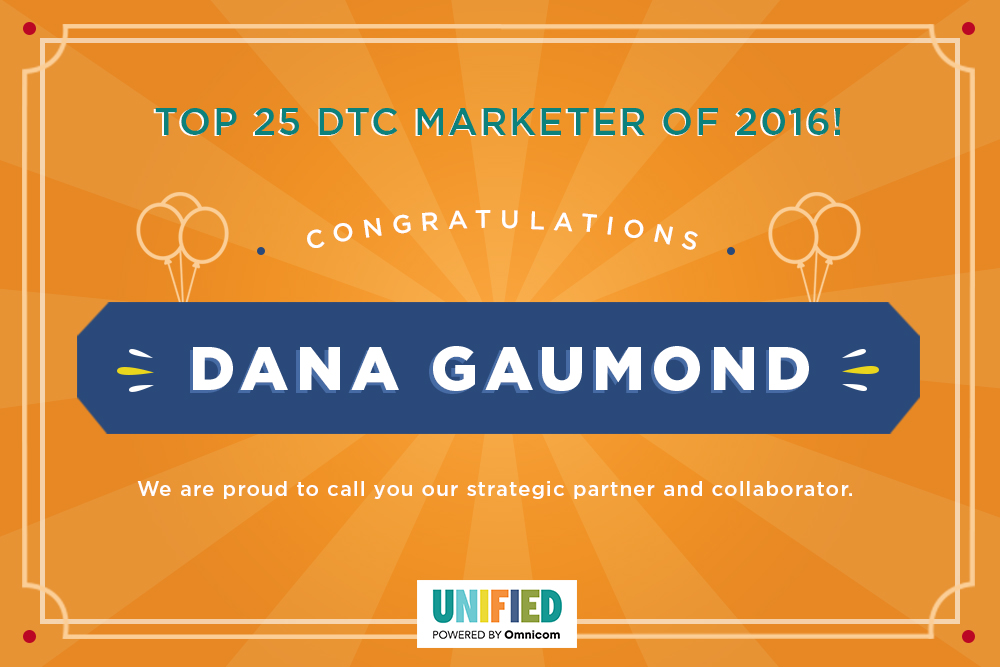
  • Dana Gaumond, Associate Director, Merck

Congratulations, Dana! From:

Unified, Powered by Omnicom


  • Sameer Goregaoker, Marketing Director, Oncology Multi-Channel Customer Engagement, Amgen
  • Keith Hopps, Director, CNS Marketing, Takeda Pharmaceuticals
  • Michael LaMotta, Director, Trade Strategy, Novo Nordisk Inc.
  • Kayte Lock, Senior Brand Manager, U.S. XELJANZ®/XELJANZ XR®, Pfizer Inc
  • Jason Marshall, Associate Director, Marketing, Stiolto Respimat, Boehringer Ingelheim
  • Brooke McCloy, Director, Marketing, Viagra, Pfizer Inc
  • Michael Moye, Director of Marketing, Cardiovascular (Xarelto), Janssen Pharmaceuticals
  • Michelle Nguyen, Consumer Marketing Lead, Shire Pharmaceuticals
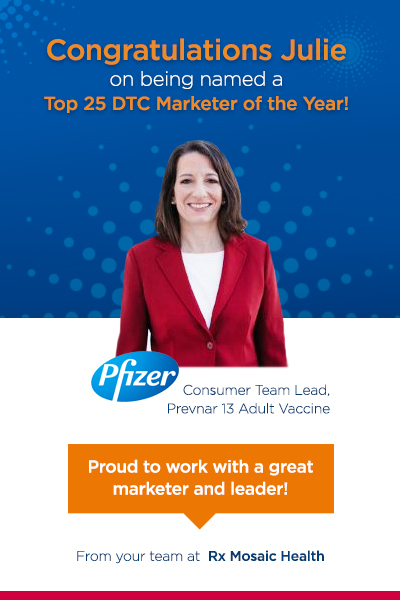
  • Julie Post, Consumer Team Lead, Prevnar 13 Adult, US, Pfizer Inc

Congratulations, Julie! From:

RX_logo

  • Kelly Reilly, Associate Director, Digital, Immuno-Oncology, Bristol-Myers Squibb
  • Derek Rieder, Senior Marketing Manager, CREON, AbbVie, Inc.
  • Brent Rose, Senior Director, U.S. Product Marketing, Inflammation & Immunology, Celgene
  • Anna Sandler, Insulins Marketing Consumer Lead, Sanofi
  • Debra Sangiuliano, Director, Pfizer Inc
  • Frank Santaniello, Urology Franchise Marketing Leader, Astellas
  • Lina Shields, Consumer Marketing Director- Immunology, Eli Lilly and Company
  • Elizabeth Turcotte, Director, Patient Hub, Bristol-Myers Squibb
  • Lizelle Valdecañas, Marketing Leader, Cardiovascular, CVMD TA, AstraZeneca

“These elite pharmaceutical marketing professionals are this year’s top contributors to the advancement of patient outcomes via direct-to-consumer pharmaceutical education and marketing,” adds DTC Perspectives Chairman and CEO Robert Ehrlich. “We would like to recognize the faces behind prominent DTC campaigns, because their hard work and dedication to fostering the industry is often not recognized. The awardees were selected from many worthy candidates.”

Select honorees will also participate in a panel discussion on current DTC marketing issues at the DTC National Conference, held April 5-7 at Westin Copley Place.

Click here to register for the DTC National Conference or contact the DTC Perspectives office at 770-302-6273.

Celebrate with the Industry’s Best

Congratulate the Top 25 Marketers in-person and in our publications! DTC Perspectives offers reserved tables with seating for 10 at the Top 25/Hall of Fame and Advertising Awards ceremonies as well as congrats ads opportunities in our DTC Perspectives Magazine/DTC National Conference Guide, on our website, and in Email announcements. Click here to view awards packages and congratulate a Top Marketer/DTC Hall of Fame inductee today.

Deadline for print congrats ads: Friday, March 3, 2017

[button link=”https://www.cvent.com/events/2017-dtc-national-conference/registration-7921d0bd6c754def8e40c271f4d2f625.aspx” color=”red”]Purchase Congrats Ads and Reserve Dinner Tables[/button]

admin


February 3, 2017 0

This week many drug CEOs met with President Trump to discuss pricing and innovation. In just two weeks Mr. Trump has sat down with a number of business leaders to push domestic investment in job creation. He pushed the drug makers to build factories here and get control of drug prices.

In return Trump promised to promote speedy approvals at FDA following his early push across industries to reduce regulations hampering business growth. Based on drug stock prices after the meeting ended it seemed to go well. Mr. Trump wants to love drug companies but to continue that fond view he asks for lower prices and domestic job creation as part of the deal. He seemed to be willing to find ways to lower prices without a heavy handed price negotiation through Medicare. Mr. Trump is not surprisingly making industry uneasy while at the same time offering rewards for cooperation.

Bob Ehrlich
“I applaud PhRMA and Y&R for going boldly in their ad.”
-Bob Ehrlich

The drug companies know that having a public image that is suffering, with both parties in Congress willing to stick it to them on price, and a President saying they get away with murder is a risky environment. So in that context the drug lobby premiered a new television campaign pushing its commitment to drug research. The ad was created by Y&R New York.

The new GoBoldly spot is very different from past PhRMA efforts. Traditionally ads plugging drug makers were kind of clichéd with stories about caring people working tirelessly to save lives. It is not that the ads were portraying the wrong message, just that they were executed in an ineffective way. The new spot also shows researchers hard at work but does it in an attention getting manner.

The ad uses the well known Dylan Thomas poem “Do Not Go Gentle into that Good Night” and adapts it to a drug research context. Read by a British voice over actor the spot has serious stopping power. It shows researchers not accepting failure as they go boldly to find cures. It is impossible to ignore when it comes on. What is very different is that the audio voice over is only the poem, while all the drug research copy is on the supers. It is a very dramatic portrayal.

Whether it will change attitudes about drug companies is hard to predict but it will get awareness. A great television ad is a start but hopefully this campaign is only the first part of a prolonged consumer effort to change attitudes. A print, radio, and web campaign is also in the mix.

That media and PR effort should address price. Americans already believe drug makers invent needed cures. This type of ad is going to get noticed but also prompt the skeptical query about price. When the President says drug makers must lower price, and Congress, consumerists, insurers, and providers agree, even a great ad is only just a start.

I applaud PhRMA and Y&R for going boldly in their ad execution. Shunning the usual voice over announcer saying how dedicated drug companies are and instead trying a breakthrough creative approach is a nice change. The drug makers have some explaining to do beyond their efforts to find cures. Telling Americans that great research costs a lot is a hard sell given Canadians and Europeans get the benefits at prices 30-50% less.

Trump may be on to something that perhaps creating thousands of new manufacturing jobs might help make higher prices a bit more palatable. I think drug makers know that Trump and other constituencies are looking for more than the usual explanations on how research is costly. Trump understands that cutting development costs in terms of approval times means more sales under patent protection and more room to deal on price. I sense that he will be dogged in ensuring that Americans see a tangible price benefit to his regulation easing.

Trump knows the art of cajoling. While many see him as bullying I think CEOs know he is just posturing to get a good deal.

Bob Ehrlich


January 27, 2017 0

Trying to be objective about Obamacare seems to be as difficult as with every other major policy issue these days. The newspaper headlines from the media are saying thousands of people will die if Obamacare is repealed. The Washington Post in a January 23 story cited estimates by medical professors who estimate the number at 44,000 annually. Bernie Sanders said 36,000 will die. These numbers assume no replacement plan which no Republican is advocating.

Bob Ehrlich
“The jury is out on whether we are better off.”
-Bob Ehrlich

I looked at some statistics to see whether Obamacare is as good or as bad as critics say. First Obamacare definitely added millions of people to the insured category. That is a fact not disputed. The HHS says 20 million people have been added to the insured rolls since 2010. About 12 million are in the exchanges and the rest are covered by Medicaid expansion. We also see several million children under 26 kept on their parents’ plan.

The issue to debate is did we add enrollees cost effectively. Are we all paying more to insure these 20 million than we should? Republicans say there are better ways to get people coverage. Did costs rise? Yes, they did for Obamacare enrollees and those covered by employers as well. In 2008 according to the Kaiser Family Foundation the average family plan cost employers $12,680 with $3,354 borne by employees. In 2016 costs were $18,142 with employees picking up $5,277. Supporters of Obamacare say costs were rising before it was implemented so this rise is not from the Obamacare provisions.

That is not the only problem. Deductibles have risen dramatically. In 2008, only 16% of employer plans had deductibles of $1,000 or more. In 2016, 51% of employees covered had $1,000 or more in deductibles. On the Obamacare exchanges the situation is much worse. Deductibles vary by type of plan chosen with more expensive premiums providing lower deductibles. The popular Bronze plans average more than $5,000 in deductibles. It is probably fair to attribute these huge deductibles partially to the coverage mandates.

We are also seeing many state exchanges showing huge increases in premiums with the average being 15% in 2016. Many families are paying well over $10,000 in premiums and deductibles. For them Obamacare essentially just covers them for a catastrophic illness. It is true they get a free prevention exam and some other free diagnostic tests but that is not much for their $10,000.

Supporters of Obamacare say having 20 million more people covered is a societal benefit worth paying for by all of us. Maybe it is, but just maybe we are all paying more than we need to if we had a different approach. The Republicans say they can provide better coverage at lower cost. They think free market insurance competition and giving the states more control over budgets can lower cost. They also think that more consumer responsibility for spending decisions will make patients more aware of cost and provide pushback on healthcare prices.

What is very clear is that Mr. Obama’s promise of lowering premiums for every family was not achieved. In 2008 he promised the average family will save up to $2,500 a year. Many markets now only have one insurer willing to provide coverage. Clearly this reduced competition is not helping lower premium rates. While more people are covered today than pre-Obamacare, the jury is out on whether we are better off. That depends on who you are. Anyone with a pre-existing condition is likely better off. Those of us who had employer coverage before are likely not better off today because we are subsidizing insurance companies mandated to cover pre-existing conditions.

Democrats find many examples of the poor or people previously denied coverage who now have access to care. They tout these as reasons to keep Obamacare. Analyzing success, however, must also include the effects on everyone who is asked to pay for it. My guess is we have better alternatives that will provide coverage for less. That does not mean all people currently insured and subsidized will be better off under a new Republican plan. What is clear from Obamacare is insuring people already sick is very expensive and that healthy people do not sign up in high enough numbers to subsidize those folks.

As a compassionate society, we should not let people lose their life savings or get no care because they get sick. That does not mean we cannot create a much more targeted and affordable plan to do that. The proof will be in the details from the replacement plans proposed. Level headed analysis rather than hyperbole is what is needed in Congress but we do not seem to be in the political mood to do that. Keeping an unaffordable plan is not the answer the American people are seeking.

Bob Ehrlich


January 26, 2017 0

DTC will be much more important in the new health care era post Obamacare. This is not just for drug companies but for all health care goods and services. The Trumpcare plan will be shifting more decisions on health care to consumers based on free market competition. Americans will be given greater control over spending a pot of dollars allocated to them by government. Although we have not seen a final replacement plan we do know it will likely contain health savings accounts, tax credits, wider choices for insurance coverage, and some minimum affordable coverage for people with pre-existing conditions.

Bob Ehrlich
“A free market will rely even more on advertising…”
-Bob Ehrlich

Americans will be encouraged to shop for health care like they do for all other products they buy. Yes I know the critics of free markets say health care decisions are different from other types of products and more important than choosing a dishwasher or cell phone. What consumers will do is give health care decisions much more consideration. Consumers probably spend a lot more time shopping for a car than for a heart surgeon. To evaluate health care decisions they will need transparency on prices and good information on pros and cons of their choices.

Health care information on products and services will become a boom industry. Rating services will spring up that tell consumers what health care services should cost and provide reviews on providers price/value. A free market will rely even more on advertising to pitch and justify services and this is where DTC will grow. We already have hospitals and physician advertising to consumers. What will change is a much more explicit price/value oriented advertising approach. As consumers are given more control over their limited health care spending, they will need more convincing on where to spend those scarce funds.

In today’s someone else pays system, we do not usually question the need for what our doctor recommends. We do not ask if that CAT Scan is essential because we never see the full bill. We do not ask for generics if a new branded drug is covered. We do not push back if the dermatologist asks to take a piece of our skin to biopsy as long as it is covered. Once we have the limited pot of dollars under our control we will be much more involved in making the go/no go decision on treatment. We all know doctors err on the side of over treatment because they do not want to be sued. That defensive medicine will be reduced as we pay more of the bill.

The critics of consumer controlled free market health say people will avoid important tests and treatments to save money. This may in fact be a problem and under treatment could be an issue with consumer controlled limited dollar plans. What we hope for is that good health care information will tell consumers what are the best investments to keep them healthy. In other words which tests/services are critical and which are just nice to do. Like it or not all health care decisions are a cost/benefit calculation. We do not, as a society have unlimited resources. Trumpcare will place more burdens on us to decide how and how much to spend on health care.

One would hope that essential health care services become more easily available at lower prices. Competition should do that. We can expect more chain medicine as big providers will emerge who can use volume to offer lower priced services. That means many smaller, inefficient providers will be forced out. Clearly when price/value becomes the main concern of consumers the market will change significantly. Advertising will become critical to tell that price/value story as consumers will push back on providers to justify the recommended service or product.

Bob Ehrlich


January 19, 2017 0

In what might be the most puzzling FDA DTC study proposed to date, the agency wants to see if consumers can recognize deceptive claims in DTC ads. In this study FDA wants to create mock ads with deceptive claims to see if consumers recognize those false claims and evaluate how that affects their perceptions of and requests for the drug. FDA is concerned consumers might ask their doctor more often to prescribe a drug hyped with deceptive ad claims.

Bob Ehrlich
“I have problems with the proposed study.”
-Bob Ehrlich

I have problems with this proposed study on many fronts. First, how are consumers supposed to know what is in the approved label to decide what is deceptive? In the study proposal apparently the plan is to plant false claims on a mock website and see if consumers can spot them. So FDA will have consumers play detective like those games where you see two photographs slightly altered to spot the changes? I just do not get the method here or how consumers should know what is an approved, accurate claim. Does FDA want consumers to be the vanguard of regulation and report claims they think are deceptive? Is FDA going to staff a hotline to receive consumer complaints?

Second, the consumer relies on FDA to prevent deception. Drug ads are already the most scrutinized ads in America. Most ads are pre-cleared well before they run. Consumers expect the claims in an ad to be vetted by FDA so what is the study goal in purposely putting in deceptive claims to see how misled is the consumer? I don’t understand an agency testing what would be the result of their own failure to effectively regulate DTC.

Third, what possible help could this study provide in future promotional guidances? False claims are already prohibited. Each branded ad must meet strict FDA criteria for fair balance. A study that proves consumers can be deceived and might be unable to know they are being deceived proves what? Is FDA trying to prove consumers who do not know what is in the approved label can be easily fooled by rogue drug companies? This study might be more appropriate for supplements or other non Rx drug health products that often make unproven efficacy claims in their ads. FDA seems to be asking a question they already know the answer to. If a drug makes deceptive efficacy claims, it is going to be more appealing to consumers. Hello, my new drug cures cancer. You interested?

Fourth, just by doing this study FDA is promoting a negative attitude against DTC. To study purposeful deception is to imply there is a broad history and likelihood that drug companies will engage in false ad making. In 20 years of television DTC ads, there are a only handful of ads that overstated efficacy. Those ads were withdrawn and in a few cases corrective ads were required. In other words why study deception when it almost never happens in DTC ads? Most warning letters are over subjective elements like distracting music or scenes, not over false claims. FDA already has procedures to punish deceptive ads. Is this deeper understanding using mock deceptive ads going to make FDA a better regulator?

Consumers deserve accurate and balanced DTC ads. Any study which helps improve those objectives are welcome. In this case, measuring how well consumers spot false ads does not, in my view, add to better ad development or regulatory guidance.

Bob Ehrlich