

A Matter of Trust-Health Information in the Age of Social Media: Who Do Consumers Turn to—and Trust?
A Shifting Landscape
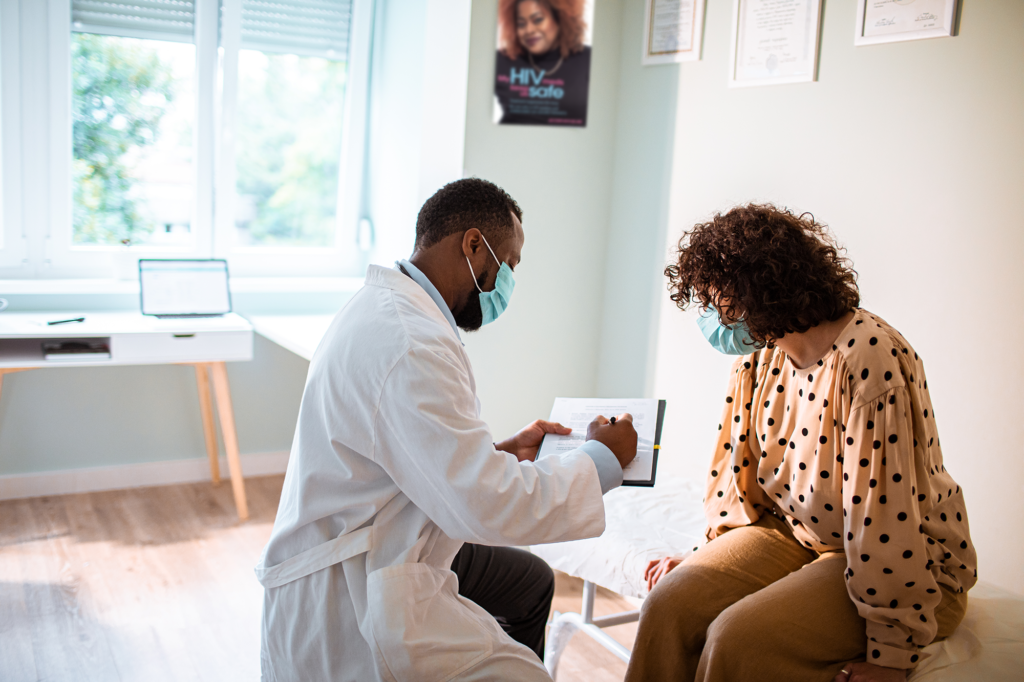
This morning, you woke up with a mysterious rash. You inspect it, assess your symptoms, ponder it, and then, if you’re like the vast majority of Americans … you Google it. With the internet at your fingertips, information comes at you fast and furious. And with the rise of user-created content on social media platforms served up in bite-sized portions, that information is more accessible—and influential—than ever.
But despite this wellspring of wellness content, many consumers remain wary of misinformation from social influencers. And doctors agree that it’s wise to think twice before you like and subscribe: For example, a 2024 study in Otolaryngology—Head and Neck Surgery found that “most nonmedical influencer-posted TikTok videos about sinusitis are inaccurate, despite being portrayed as medical advice/educational.”
WebMD and The Harris Poll engaged 2,005 U.S. adults in an online survey in April 2024 to learn more about their attitudes toward the health information they get online and via social media platforms. This data can guide best practices for marketers seeking to understand the key question: Who do consumers gravitate toward and hold in high regard for medical advice?
The bottom line: Reliability, transparency, privacy, and trust guide consumers’ clicks when it comes to health content.
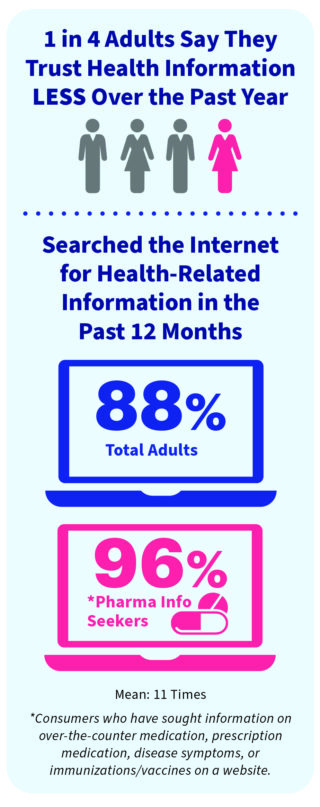
1 in 4 Adults Say They Trust Health Information Less Over the Past Year
Searched the Internet for Health-Related Information in the Past 12 Months
88% Total Adults
96% *Pharma Info Seekers
Mean: 11 Times
*Consumers who have sought information on over-the-counter medication, prescription medication, disease symptoms, or immunizations/vaccines on a website.
Trust Trends
Poll data shows that compared to last year, more pharma info seekers frequently rely on health information from health-related and news sites than social media platforms. Overall trust in online health information has dropped, primarily driven by misinformation on social. What specifically is eroding pharma info seekers’ trust?
35% say anyone can post content and claim to be a professional, even if they aren’t.
33% say they don’t know if people are telling the truth or being paid to promote things.
30% say it’s hard to determine what’s true and what’s false.
Privacy concerns are also paramount. As new state privacy regulations continue to take
effect, consumers have increasingly questioned influencers’ and social media platforms’
ability to protect their personal information. For many, opening the door to targeted ads
that concentrate on their chronic condition, for example, is a turnoff.
Privacy Concerns Also Aligned With Perceptions Around Ad Targeting
Attitude Among Pharma Info Seekers Toward Health-Related Advertisements
Top 2 Box % Somewhat/Strongly Agree
75% “When I’m on social media, I don’t want to see ads reminding me of my health conditions.”
68% “I would prefer a random ad not based on my personal or demographic data.”
Under the Influence
Despite the deluge of health and wellness content, pharma info seekers are much more likely
to follow food, exercise, lifestyle, gaming, and travel accounts than those with a medical focus.
Only 15% of pharma info seekers follow medical professionals, while only 12% follow accounts for special health conditions.
The creators they trust enough to follow attract them with three characteristics:
- They’re a medical professional.
- They’re a real expert in the field.
- They include references and citations.
Clickers are picky for a reason:
68% of pharma info seekers say they often encounter claims that appear to lack medical or scientific review or are from someone with no true credentials.
Most Say Influencers And Creators Are Unreliable Sources of Health-Related Information
Attitude Among Pharma Info Seekers Toward Health-Related Advertisements
Top 2 Box % Somewhat/Strongly Agree
85% “Social media influencers/creators are not reliable sources of health-related information.”
76% “I am skeptical of a brand or product if a social media influencer/creator is endorsing it.”
Embrace Evolution + Keep Facts at the Forefront
Where We Are:
Social media platforms aren’t going anywhere. Neither are consumers’ desires to seek out advice and education about their chronic conditions. And people want trustworthy, discreet, sound information from experts as they scroll. Despite the rise of health information circulated in social media platforms and from influencers, pharma info seekers are relying more on health websites as a trusted source of health information, with a trust level 3 times higher than social media platforms or influencers. Context is critical for pharma messaging. Pharma info seekers don’t like to be reminded about their conditions when on social media platforms and are averse to being targeted by brands using their personal data.
Health websites have a trust level 3 times higher than social media platforms or influencers.
Where We Go From Here:
Leverage the platforms in use in the language of the user without compromising sound science, says WebMD Chief Medical Officer John Whyte, MD, MPH.
“Less is more. Too often, content providers overwhelm patients with too much information. Instead, they need to focus on nuggets of information. The most successful influencers often create content that is brief in nature, given the attention span of users in those platforms. They then build a following, where people come back to learn more.”
The research was conducted online in the U.S. by The Harris Poll on behalf of WebMD Corporation among 2,005 adults ages 18 and over who reside in the U.S. The survey was conducted April 11–22, 2024.
Data are weighted where necessary by age by gender, race/ethnicity, region, education, marital status, household size, employment, household income, and political party affiliation to bring them in line with their actual proportions in the population. Respondents for this survey were selected from among those who have agreed to participate in our surveys. The sampling precision of Harris online polls is measured by using a Bayesian credible interval. For this study, the sample data is accurate to within ± 2.6 percentage points using a 95% confidence level. This credible interval will be wider among subsets of the surveyed population of interest.


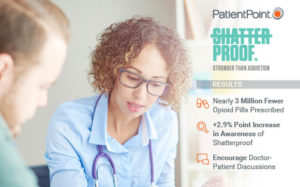 To help combat opioid addiction, PatientPoint® collaborated with Shatterproof – a nonprofit organization focused on ending the stigma of addiction and improving addiction treatment – to create a powerful opioid education program at the point of care. It launched nationwide in October 2017 across the digital PatientPoint engagement platform, reaching an estimated 15 million patients and caregivers each month in waiting rooms, exam rooms, and in the physician back office. The content is designed to increase the awareness of opioid addiction and encourage doctor-patient discussions about other treatment options.
 The Tylt is the fastest growing social polling and opinion
  For healthcare campaigns, the process begins with locating the right patient and encouraging them to share their opinion on a personally meaningful health topic. Patient advocacy becomes democratized when declared sentiments, informed by supporting evidence, are shared socially. By bringing structure to health conversations as they trend across social, patient insights can be identified and addressed in the next wave of interactive content, positioning the brand as a partner in the journey to better health.
 And it’s becoming increasingly clear that brands have had enough.
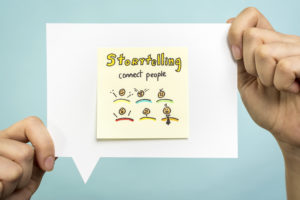 Branding: What Science Says About Engaging People


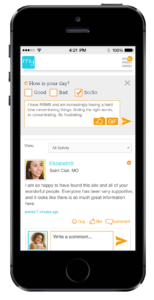
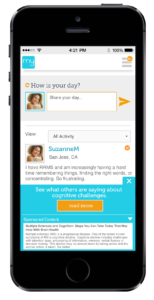

 Many people associate weather conditions with their health and wellbeing. Perhaps you have family members claim to be able to sense changes in the weather because they feel a migraine coming on, friends who swear they can forecast rainfall better than the meteorologists due to increases in pain levels within their joints, or even co-workers who claim to be allergic to certain types of weather. Observations about the interactions between weather and health are not a modern phenomenon. People have been making them for almost 2,500 years—since the writings of Greek physician Hippocrates—and correlations between weather and wellness, if proven, are potentially valuable information for organizations and companies across the healthcare economy.