
Latest News


May 12, 2017 0

Specialty Drug Marketers Can Tap into Patient Stories

Stories are ingrained in us from the time we are infants. The nighttime ritual of parents and children cozying up with a storybook or two is a genuine and enjoyable encounter, one with an underlying message or lesson that is served in a palatable way. Once we begin reading for ourselves, we turn to stories to bring clarity to a topic, brighten an experience, or learn something new.

Patients often have many stories of their own to tell, no book needed. At each story’s core are kernels of information that can help biopharmaceutical marketers, healthcare professionals, and other patients understand an individual’s challenges and triumphs as well as reveal unmet needs and gaps in care.

What can be learned from the tale of an active female patient with rheumatoid arthritis? As it turns out, quite a lot. The story of Lisa Hehn’s journey includes a lot of twists and turns, revelations, and teaching moments relevant to brand marketers. Patient stories resonate. They illustrate real-life experiences, pull at heartstrings, and humanize disease.

Lisa’s Journey

Six months after her second child was born by cesarean section, Lisa woke up with total body pain. As a young mother, she needed to be well in order to care for her children and keep up with the daily demands of an active lifestyle that included walking, dance classes, and regular gym visits.

Lisa set out on an odyssey to discover the root cause of her pain and find a solution, relying primarily on library research and the expertise of numerous physicians and other healthcare professionals. Her pain was managed with anti-inflammatories, steroids, and other medications that left her with serious side effects including stomach bleeds. She wore wrist braces to carry her children, and even added carpet padding to her slippers to soften the pain of each step she took.

Years passed before a specialist diagnosed Lisa with rheumatoid arthritis and ultimately prescribed a TNF inhibitor to manage her disease. The change for Lisa was life-altering, in fact, she’s said that the biologic gave her life.

Drugstore Aisle Opportunities for Specialty Brands

Patient narratives like Lisa’s can help specialty brand marketers pinpoint effective marketing strategies across various channels at every step of the journey. Although Lisa’s disease is now well managed, that was not always the case. Prior to her diagnosis, she frequently shopped at the pharmacy for OTC solutions to address unidentified pain and other ailments related to an unknown disease.
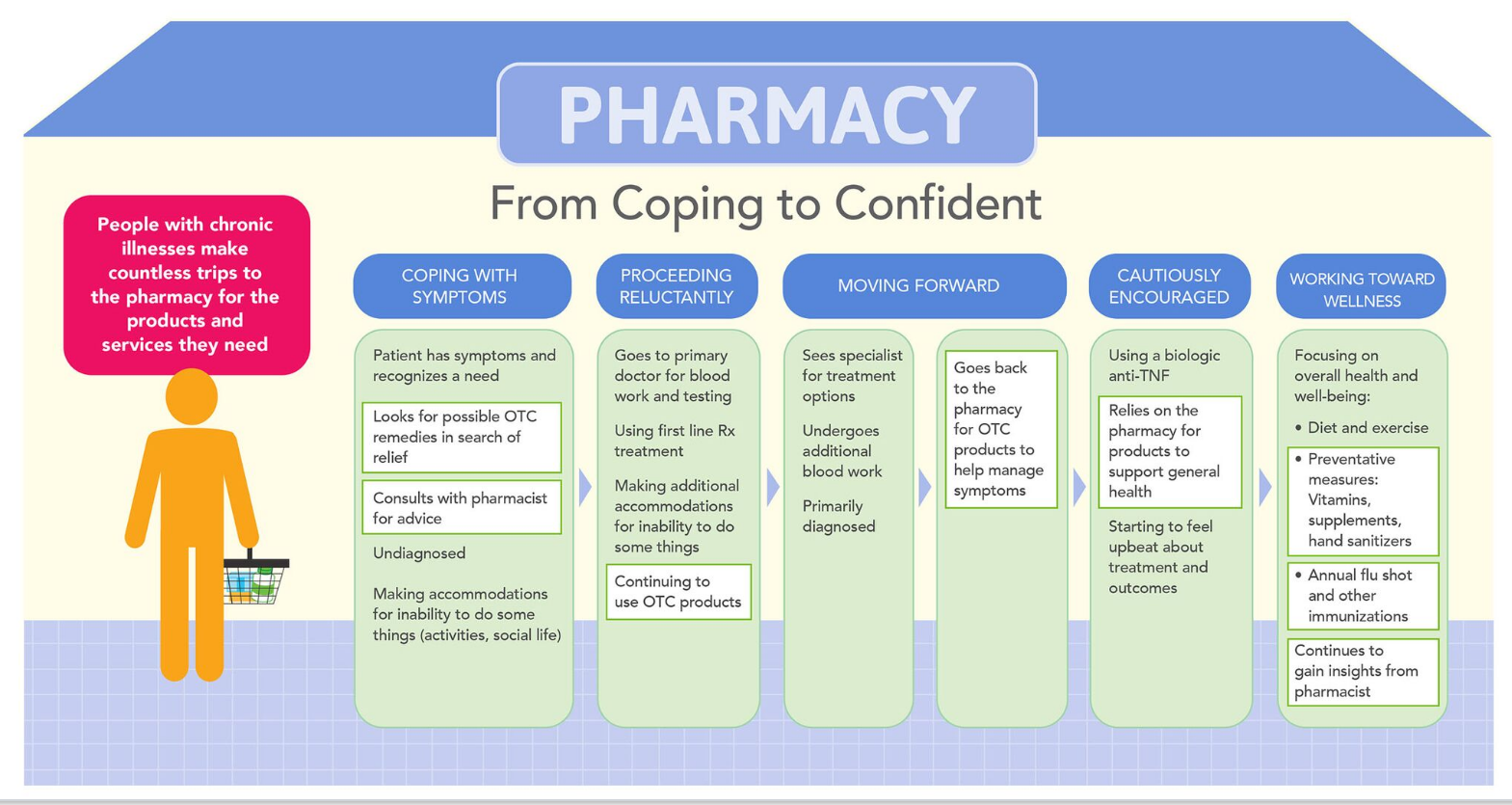
Once diagnosed with an autoimmune disease, prevention became a regular part of Lisa’s day. To minimize exposure to germs and viruses and thereby prevent illnesses, Lisa turned to the pharmacy for products including vitamins, over-the-counter pre-cold remedies, and hand sanitizers. In addition, as a mother, Lisa often shopped for health remedies and other products for her husband and children.

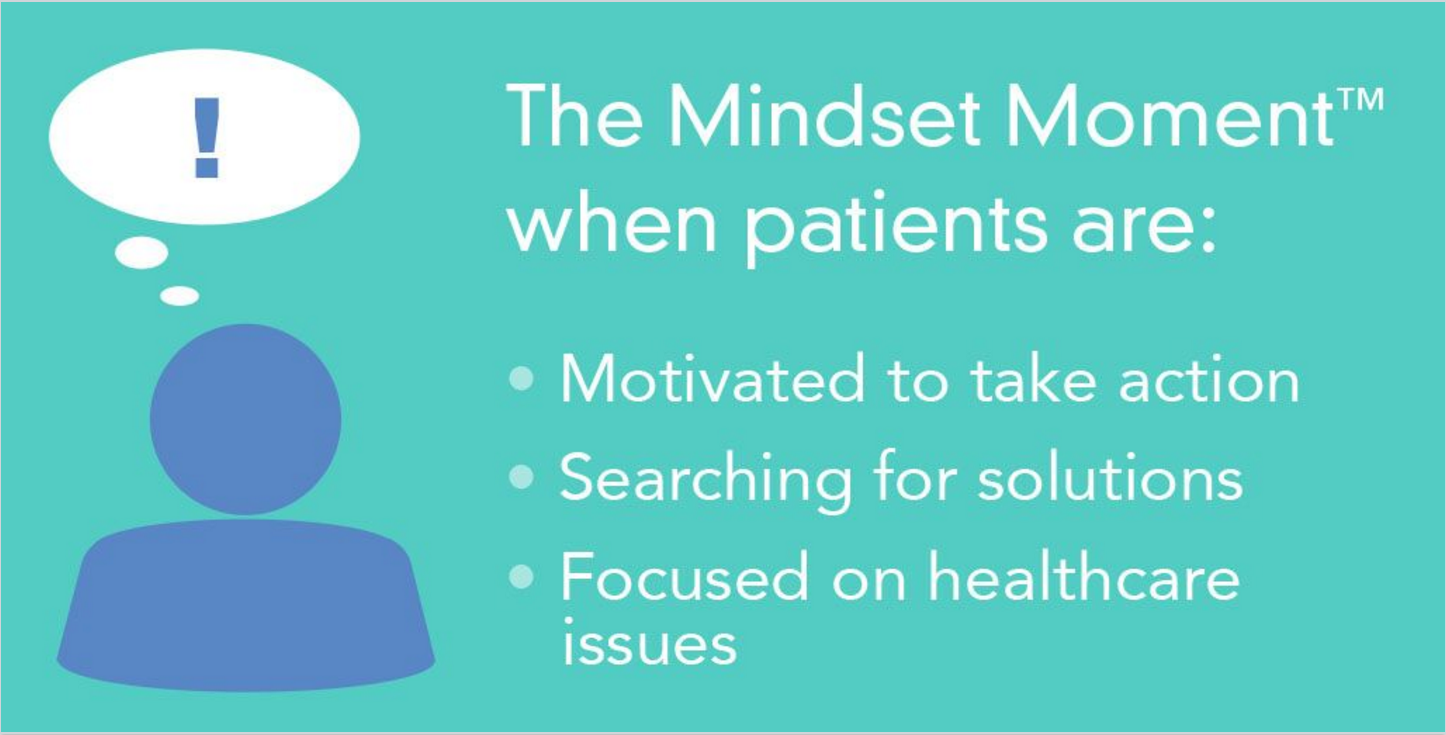
Patients gather information from various touchpoints and needs continue to evolve as a condition unfolds and treatments are prescribed. The pharmacy is a prime touchpoint because it’s a venue patients visit when they’re open to, and often seeking, health-related solutions and education.

At the beginning of the treatment continuum for a chronic disease such as RA, a patient may be most interested in the potential side effects of a particular therapy, whereas over time, concerns shift to more global issues including affordability and adherence.

Even now, Lisa seeks solutions for occasional health needs both related and unrelated to her main diagnosis. Though Lisa’s medication is filled through a specialty pharmacy and shipped to her home, she turns to retail and community pharmacies on a regular basis for a variety of needs.

Weaving the Pharmacy into a DTC Campaign

When handed a new diagnosis, and prescribed a new medication – whether traditional or specialty – patients often hunger for information, feedback, and guidance. Though each individual patient will seek information in different ways, knowledge is often gathered from multiple sources.

So how can the patient perspective help shape a DTC campaign? Listening to the patient experience can help brand marketers identify lingering needs and information gaps. In Lisa’s case, being prescribed a biologic nearly two decades ago left a lot of unanswered questions. She was starved for more information about RA but also how the biologic worked, how it would improve her symptoms, and what she could do to maximize its effect.

Though Lisa feels more medically savvy now out of necessity, at the time she would have liked access to educational content with patient-friendly language. To her, the pharmacy is well suited to disseminate simple messages about particular diseases and conditions.

When Lisa enters a pharmacy, she has health on her mind and she knows the onsite pharmacist is available to address questions and concerns. She finds the setting professional, comforting, and accessible for health-related messaging. In fact, if the option presented itself, she’d jump at the chance to pick up her specialty medication in the neighborhood pharmacy rather than receiving a shipment in her home.

Visiting the pharmacy is not a one-time event. Patients have different needs at each point along the way, affected by medication, age, and a variety of other factors. Patients with chronic diseases often continue to cope with a few minor symptoms, particularly at the beginning of a new treatment option. Therefore, the pharmacy can be a vehicle for driving patients to other resources such as a comprehensive disease website or online tools to help manage the disease burden.

Build Customer Awareness at the Pharmacy Level

With shrinking budgets and increased scrutiny of traditional DTC advertising, marketing tactics need to be more targeted, more effective, and less expensive. Specialty pharma marketers in particular are tasked with learning about the people taking their products, and that includes uncovering their needs. Who can clearly define patient needs and wants better than the patient himself?
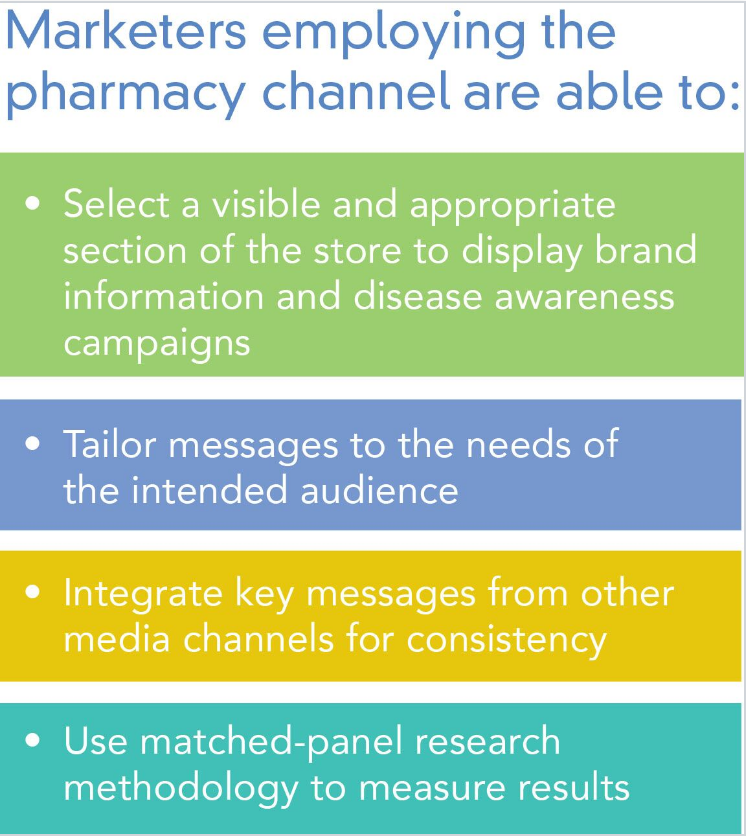
Listening to patients can help marketers identify the best messaging approach before creating a branded shelf aid in the pharmacy or creating a magazine advertisement. Targeted products for specific populations, like RA for example, require a targeted marketing plan even though the number of patients affected by the disease is large. In some cases, the patient pool prescribed specialty medications is quite small which requires a more focused messaging approach.

Patients rely on specialty pharmacies to dispense specialty medications; however, the same patients are also regularly stopping by retail pharmacies. In fact, these patients may spend even more time in drugstore aisles than the average consumer. It’s a moment in time when the patients have their own health concerns – and likely that of a child, parent, or spouse as well – top of mind.

The pharmacy is an appropriate setting to deliver strong messages to patients while they’re looking to improve their health. Drugstore aisles are a proven platform to reach patients with targeted and specific information that helps establish a close link and provide the support needed. In-store campaigns can also open the door to other media channels, driving the patient to continue the brand experience. Integrated programs that include multiple touchpoints such as mobile and internet reinforce messaging found in store aisles.

The Next Powerful Patient Story Awaits

Marketers hope the messages they develop motivate patients to take action. Some patients may respond positively to information about how a newly marketed product differs from those that have been available for years. Another patient type may want to be informed in order to open a conversation with a pharmacist or physician. The communication’s value and credibility increases exponentially by having a healthcare professional available in-store. Patients can easily discuss questions and concerns with a pharmacist and in some cases, a nurse practitioner or physician assistant.
We’ve all heard of the cardiologist who has an epiphany about what a patient truly needs once he himself has had to endure triple bypass surgery. When patients share real-life experiences of their diagnoses, it’s the closet way to feel their pain and see their struggle without actually having the disease ourselves. Keeping real-life patient stories in mind can elevate a marketing campaign’s effectiveness and ensure the product and patient develop a genuine and worthy connection.




Kathleen Bonetti


April 21, 2017 0

No, the above is not a movie title. It is referring to an op-ed in the 4/17 Washington Examiner defending DTC by former FDA official Peter Pitts. The op-ed lays out the case why the attacks on DTC are flat out wrong or fake news as Mr. Pitts calls it in the title. Mr. Pitts correctly debunks the argument that drug companies spend more on marketing than R&D. He points out that the drug industry spent $70 billion on pre-approval R&D versus $5.6 billion on consumer advertising. He says you have to add a lot of detailing, sampling, written communications to physicians, administrative expenses, and other expenses that would not be considered marketing by most of us to exceed R&D spending. Based on several sources I found it is really about $20-25 billion spent on true marketing activities including consumer/physician advertising, physician education and sampling.

Bob Ehrlich
“Thank you Mr. Pitts.”
-Bob Ehrlich

The news media and drug industry critics like to make DTC the fall guy for high prices. Mr. Pitts correctly points out there is no evidence of that. I have said in the past that actual DTC spending is much less than reported spending at about 70% because drug companies pay less as volume buyers of ads. So that $5.6 is really about $3.9. IMS reports U.S. drug spending of $310 after discounts in 2015. How much can $3.9 drive price in a $310 billion market. Very little. While it is true DTC does raise awareness for new branded drugs, DTC is also the raising of awareness of competitive drugs. Payers play one DTC drug against another to get lower prices.

Mr. Pitts reminds critics that DTC has many benefits of raising awareness of diseases, and in 6% of DTC inspired doctor visits a previously undiagnosed condition is found. He also says only 7% of doctors report feeling pressure to prescribe an advertised drug. Mr. Pitts admits drug makers do DTC ads to sell more product. That does not make it bad or hurt public health.

As I have said in many previous columns, the world of prescription drugs has numerous constituencies. There are no truly objective ones despite a widespread belief that the doctor is always prescribing what is best. Doctors prescribe what they are experienced writing, and some are reluctant to adopt newer drugs. They may not be current on the newest treatments because of time constraints. Insurers obviously want to pay as little as possible on their drug bill and resist branded drugs. Government also is not anxious to pay for expensive drugs given the budgetary issues faced. DTC is just one more subjective constituent making a case for patients, doctors, payers, and government to consider a new brand.

So, thanks Mr. Pitts for warning the public not to fall for convenient sound bites against DTC ads.

Bob Ehrlich


April 17, 2017 0

As I sat through the many DTC presentations last week at The DTC National Conference I took note of the people actually creating DTC. They all struck me as passionate about their products and their customers. While it is easy to be cynical about the drug companies as corporate entities it is harder when you see their employees discuss DTC.

I wish Bernie Sanders could have a dialog with these people who actually create DTC ads. It is easier to hate a multibillion dollar corporation than the people who work there. In 17 years of doing these conferences, never once did I hear a drug company delegate publicly or privately state a desire to put profit over patient well being. That does not mean there are no issues on pricing, overuse, safety or effectiveness. What it does mean is the people who work on these drugs really do care deeply about helping patients.

Bob Ehrlich
“Making a profit while doing good…”
-Bob Ehrlich

We heard about the great new PhRMA GoBoldly industry campaign from its agency creators Y&R. What we saw was the use of real researchers who work at the drug companies tell their stories on developing new drugs. We might think from listening to critics that drug researchers are working on “made up” diseases just to hook us on treatment. We see in reality researchers spending their whole careers to cure cancer, Alzheimer's, depression, diabetes, asthma, and many others. They care about patients, not something you hear from our critics, who see conspiracies at every turn.

While it is very clear that our advertising is meant to create awareness and designed to sell more product, that is not a negative. In fact all the competitive DTC leads to better products and more price competition as payers and patients are aware they have choices. True, if every doctor and insurer was totally knowledgeable and acting always in the patient interest, maybe DTC would not be needed. We know, however, that is not the real world. DTC just acts as a catalyst to make all constituencies more aware what is out there. DTC provides a push for insurers to cover new treatments as we know they will hesitate based on cost.

One of the interesting recurring discussions was over how to deal with price. We had several legislative experts tell us what Congress may do to lower drug prices. It is likely something will happen to mandate, encourage, cajole, embarrass, or incentivize drug companies to lower prices. There are a menu of options and none of them great for drug companies. The bottom line is the American consumer does subsidize prices for Canadians and Europeans. That is a very difficult reality with no good solution.

Dr. David Kessler, former FDA Commissioner, said he is not anti DTC, but thinks we must understand that advertising high price drugs may be a step too far. He was against DTC branded ads on television when he left the FDA in 2/97 and after he left we all know in 8/97 it was allowed. He does appear to accept DTC as he says it is the “purest” form of advertising because it follows approved labels. He warns us not to ever do off label DTC, something the courts may eventually allow but no drug company will likely risk doing for DTC. Off label use is something better left for drug company and physician discussions.

The many case studies we heard from drug marketers clearly showed the first priority for them is to educate and help patients. While well aware of the need to get a positive ROI they see that as the end result of helping patients. It was great to spend a few days with this group of dedicated professionals who chose to work in this industry to help people. Profit is what drives the engine for drug makers, but making a profit while doing good is not an inconsistent goal.

Bob Ehrlich


April 11, 2017 0

The leading forum for direct-to-consumer (DTC) advertising thought leaders honored a dynamic group of pharmaceutical companies and brands at the much-anticipated DTC National Advertising Awards. The awards were part of the 17th Annual DTC National Conference held April 5-7 in Boston. Sponsored by Health Monitor Network, the 2017 Advertising Awards showcased the best marketing and advertising across 17 categories.

“The DTC National is exciting each year for us as a celebration of the creativity and effectiveness of DTC consumer promotion,” says Ken Freirich, President of Health Monitor Network. “As an entrepreneurial company developing creative solutions to facilitate patient and HCP dialogue, we are pleased to sponsor the awards and to recognize the many successes in the marketplace.”

The 2017 Ad Awards showcased exemplary work spanning multiple media and strategic categories. During the Advertising Awards Dinner held on April 6, Gold, Silver, and Bronze winners were announced for all 17 categories.

“We are proud to celebrate our 17th Annual DTC Ad Awards ceremony,” says Bob Ehrlich, CEO of DTC Perspectives. “The inclusion of new categories and more awards over the years is a reflection of the success of the industry as a whole. Congratulations to all of the winners and we look forward to recognize innovation for years to come.”

[button link=”https://www.dtcperspectives.com/dtcn/2017-ad-award-finalists” color=”grey”]View Ad Award Winners[/button]

[button link=”https://www.dtcperspectives.com/dtcn/ad-awards-reprint-form/” color=”grey”]Order Ad Award Reprints[/button]

admin


April 3, 2017 0

The basic problem in American politics today is we are asked choose a side. Either we are supposed love Obamacare or hate it depending on our political affiliation. That we somehow must think Obamacare has been either a savior or villain is the fault of our self serving politicians. Both sides are equally to blame. Democrats seem to love government based solutions and Republicans like to think that if we could just get government out of the way all our problems would disappear. The older and hopefully wiser I get the less convinced I am that either side is right espousing ideological purity.

Bob Ehrlich
“Unless we fix the underlying issues deductibles will keep rising.”
-Bob Ehrlich

Here are the problems we face no matter what side you are on. Obamacare greatly expanded coverage but premiums and deductibles rose significantly particularly for those making a middle class salary. While most of us get coverage through employers that doesn't mean we are unaffected by Obamacare. Employers have held premium increases somewhat in check but have done that by increasing deductibles.
Obamacare did not achieve the promise of lowering premiums for the average family. That certainly did not happen for most of us covered by employers. On the other hand it did allow many lower income people to get basic coverage through Medicaid and the exchanges. That is a good outcome for them, but we all subsidize that through higher taxes and increasing costs for our healthcare.
Like it or not we are now a country that has shifted much more of the healthcare cost burden to the consumer. This is mostly through those higher deductibles. They rose 12% in 2016 for the average employer based plan to $1478. That is cheap compared to people buying plans on healthcare exchanges where the family deductible will be over $12,000 in 2017 for the Bronze plan. With that kind of deductible most families are just getting a plan which they can use when serious illness hits.
So why are deductibles so high? First we added a lot of people with pre-existing conditions. Second we capped the cost of coverage to older folks while charging young people more than their fair share. Not enough young people are signing up so we are seeing insurers raising deductibles to lower their exposure.
Republicans and Democrats must get around the war of ideology and actually work the problem. A dose of competition across state lines is an option to consider to increase the number of insurers in the market. So is a reduction in mandated benefits to lower the cost to the younger age population. There are better ways to provide health services at lower cost such as reducing regulation to allow more physician assistants and nurses to do what physicians do.
There is no shortage of good ideas. The barrier is we have this ridiculous idea that you must love Obamacare or think it is the end of civilization. Republicans shout for all out repeal and Democrats blindly call for expansion to single payer. How about we meet in the middle? There is no shame in admitting Obamacare has some good points and bad points. There is also nothing wrong in thinking HHS boss Dr. Tom Price has some solid ideas to lower costs. Instead Nancy Pelosi and Chuck Schumer have continually vilified him as someone who wants to take away your coverage.

President Trump has shown little desire or aptitude for getting into the policy weeds here. He ran on Obamacare being a disaster but beyond a few talking points I doubt he understands the realities of reform. It will take political courage to compromise and blend free market reforms with Obamacare. Right now the war in Washington will prevent that. Dems want to pander to the progressive wing and Republicans are unsure how far right to go trying to appease the Freedom caucus.
Unless we fix the underlying issues deductibles will keep rising and all of us will be essentially self insured except for a catastrophe. That is not all bad since spending our own money will make us more cautious consumers. We will demand less testing and negotiate harder with providers. More services will be developed to help us evaluate price/quality of physicians and hospitals. That will make providers focus on value based marketing.
It is not surprising why Congress’ approval rating is so low. And healthcare is a perfect example of the failure to help the American people because of pig headed ideological positions not based on facts. They deserve the criticism and they are on a path to zero approval. Sad indeed but here we are unless moderates re-emerge on both sides to actually solve problems. That is something that will take guts, and guts are in short supply right now on Capitol Hill.

Bob Ehrlich


March 28, 2017 0


While the primary focus of patient adherence programs today has shifted from the product to the patient, the communication barriers that hinder patient interaction and engagement are still common. Many of these barriers can be overcome by investigating and addressing the root causes of issues, which often occur in either the basic program design and/or within technology systems.

This article looks at three common obstacles and how they can be addressed in order to improve communications, and as a result, improve the adherence rates and outcomes of your programs.

The Obstacle: Patients lack interest in participating, or the program does not allow for patient interaction.
The Solution: Design a program that emphasizes empowerment and two-way communication.

A basic principle to keep in mind when considering the communications modes of your programs is that patients do not want to be “compliant,” they want to be empowered. The more that patients understand why they need to take a specific medication in a timely and consistent manner, or how they will benefit from participating in a treatment regimen, the more likely they will become fully invested in the process to reach a desired end goal. Poor communication often results in patients who don’t feel that they program reflects their needs, concerns, and interests. Enabling for two-way communication is crucial — that means allowing ample opportunities and channels for feedback, and tailored resources to be shared at the right time throughout the entire course of the program.

The Obstacle: Communication with the patient is “one size fits all.”
The Solution: Allow for interactions that are flexible and relevant.

Many factors come into play in the communications of adherence programs: the channel (phone call, text, online chat, etc.), the frequency, the topics discussed. But all too often these communications are designed with solely the general group patient profile in mind. While overarching information about the patient profile is important, it needs to be married with the flexibility of individual experiences and preferences. There are many factors that influence patient behavior — age, gender, family, socio-economic, financial, and logistical — and each of these adapts the patient journey. For example, a more responsive model could mean stratifying patients by level of risk and adjusting the information provided, and the frequency of contact, depending on the needs of the patient at that particular moment. Interactions need to adapt to the patient, not just the patient population.

The Obstacle: Communication systems are siloed — they inaccurately portray a straight narrative, and lack the necessary insight into the entire patient journey.
The Solution: Leverage new technology to assist in program coordination and tracking.

Technology is critical in adopting an adaptive approach to patient communications, but it needs to be orchestrated and adaptive. Taking advantage of a system that synchronizes with the ups and downs of a patient’s journey can help manage variation and provide guidance and insights through intelligence and integrated analytics. Far too long, systems have been focused on single business models or functional areas. This hinders patient communications by creating a fragmented customer journey. As programs become patient-centric and holistic, the technology should follow suit. A platform that allows for evolving interactions with a patient can present a big-picture perspective, and through continuous sensing and orchestration, offer real-time insights and assist with decision-making.

While it’s true that the most effective patient adherence programs keep patient engagement at the heart of their programs, that’s no longer sufficient as a stand-alone element. Considering what patient-centricity really means in terms of communications — and how technology can make a difference — will allow for adherence programs to adapt and improve in real-time, and help further their goal of improving patient outcomes.

Pega Decision Hub Patient and HCP JourneyDiagram, courtesy of Pegasystems, illustrates how patient communications across all channels meet in one hub, combined with the ongoing communications with healthcare providers. In this article, the challenges to patient communications are in focus.


ABOUT THE AUTHORS

Ed_ChaseEd Chase is the director of Life Sciences Solutions at Pegasystems, where he manages the strategy, design, development and marketing of enterprise software products and solutions. He has spent more than 20 years in the software industry, with the majority of those in life sciences, covering both R&D and Commercial solutions. Ed brings a deep technology background that includes product management and development for enterprise applications, business process automation, imaging and electronic documents, and information assurance and authentication. Currently he leads the Patient-Centric strategy, marketing and product development for Pega’s life sciences applications. He can be contacted via email at Ed.Chase@pega.com.

Susan Mattson_BW-webSusan Mattson has more than 25 years of management experience in the pharmaceutical, healthcare and education industries. She has owned her own business development and marketing firm and has served as the director of public relations for a major hospital, with responsibility for marketing, public affairs, community health and development.  She was also previously the assistant vice president of public relations and marketing for a major university. She began her career as a U.S. Naval Officer in public affairs. Susan currently serves as a senior director in account management for programs at C3i Healthcare Connections, with oversight of several patient engagement, access and reimbursement programs and business process outsourcing programs. She can be contacted via email at Susan.Mattson@Telerx.com.


For more about these companies, follow C3i Healthcare Connectionson on Twitter @C3iHC, or follow Pega @pega.

admin


March 24, 2017 0

We all know about patient support forums. I am sure most of us check one forum or another about a condition we or a loved one have. Only recently did I have an occasion to see how powerful patient to patient sites are in influencing treatment and thought about how important it is to integrate DTC strategies with these groups.

My story involves the male nemesis called the prostate. At my advancing age I get tested annually for PSA levels which have been rising the last few years to a borderline level. My internist was reassuring but suggested that I can see a urologist if I felt concerned. I like to be a well versed patient so the research began which led me to read everything on high PSA levels. I found much information on how so many men get unnecessary treatment which starts with high PSA levels to needle biopsy to removal of the gland. Many of those men have lifelong urinary incontinence and erectile dysfunction from treatment for something that would never have killed them had it been left alone.

Bob Ehrlich
“Powerful patient to patient sites are influencing treatment.”
-Bob Ehrlich

I also found new methods to further evaluate high PSA levels without a biopsy. The patient forum approach led me to find these alternatives and the leading edge providers. I discovered that urologists do what they know best and that is recommend an often painful biopsy which is a random sampling of tissue. Armed with alternatives such as a Multiparameter MRI I visited the said urologist. After checking my urine stream with an ultrasound which was fine and had nothing to do with my complaint, he recommended a biopsy. Now this was before he even examined me. No way I replied would I do a blind biopsy without an MRI first. He said those are inaccurate but my research and forum buddies led me to the latest findings which showed they are much more accurate than a blind biopsy.

So I finally cajoled the MRI script from the urologist. I then used these patient forums to find an expert who specializes in reading prostate MRI images. I found one a few hours drive and went. I also saw that insurance would not cover it so I shopped around. The self pay quotes varied from $695 to $2500. Sometimes you get what you pay for but it turned out the lower price provider was the best.

My result was that there was nothing to biopsy and my PSA was rising along with the size of the gland. Long story but the lesson learned is patients talking to patients saved me 12 needle shots to my little walnut sized prostate gland and potential infection. By the way those biopsies miss 30% of actual cancers because they sample only 1% of the tissue. The MRI catches 93% of any significant cancer. Since the percent of men who have microscopic cancer in the prostate is equal to their age, you do not want to find those tiny indolent cancers that will never do you harm.

Doctors probably hate patients like me who read medical journals and discuss options with other patients. Too bad. This is the future of medicine particularly as we self fund our treatments more and more. The idea that doctors and patients have a strong bond of trust is declining. I trust my primary care doctor but have a lot less faith in the specialists who do what they know how to do.

How should drug companies interact with patients on these sites? Given regulatory issues it may be difficult to actively participate. Certainly by monitoring them, however, you learn so much about patient concerns, and how they talk about their issues. At least it gives you a good feel how to develop the right approach to discuss your drug with them. I know providers actively engage and respond to misconceptions about treatments and side effects. So doctors and patients do interact on these sites.

In my case I have become a fan of the patient to patient sites and now help others in my same position. Doctor, get ready for the super patient who takes charge of their care because that is your future.

Bob Ehrlich


March 17, 2017 0

The final 2016 spending was released recently showing $5.66 billion versus $5.18 in 2015. DTC Perspectives has received some detail on these numbers and we ran some analysis explaining the growth. In 2014 spending was $4.33 billion so the last two years has seen growth of 31%. The 2016 number was a record and we expect $6.0 billion to be reached in 2017.

DTC spending has grown historically when new brands launched DTC programs.  That certainly happened in 2016. Total spending rose about $500 million in 2016. That rise can be largely explained by new brand spending. There were 12 new brands that launched significant DTC efforts in 2016 accounting for about $730 million in media. That is about 13% of the total. There were some huge spenders among new brands. Cosentyx, Entresto, Rexulti, Taltz, Tresiba, Viberzi, Trintellix, and Entyvio all spent more than $50 million in their launch year.

Bob Ehrlich
“The 2016 number was a record and we expect $6 billion..in 2017.”
-Bob Ehrlich

Adding to the new brands were brands in their second year adding to their spending. Trulicity and Breo Ellipta each added over $100 million to their 2015 total. Adding new brands and newer brands increasing spending resulted in an increase of over $1.2 billion versus 2015. With a net rise of $500 million that means some brands must have reduced or cut spending entirely.

Several key spenders withdrew entirely from DTC advertising. Tanzeum, Auvi Q, Spiriva, Duavee, Levemir and Afrezza withdrew entirely accounting for $210 million in reduced media. Large cuts in budgets were seen in Cialis, Latuda, Jublia, Onexton, Belsomra, Crestor, Anoro Ellipta, Kerydin, and Osphena. These cuts reduced spending by $500 million.

There is a diverse portfolio of brands advertising. There are 58 brands with significant budgets of more than $25 million. The top 20 brands dominated and spent 55% of total media. While most DTC brands do both television and print there are many that have small budgets used for print, point of care and internet. There are 84 brands with budgets large enough to do at least print and some targeted web and point of care.

On a company basis Pfizer is the dominant spender at $1.2 billion up about 10%. Notable was Novartis spending $250 million up from less than a million in 2015 from new entries Entresto and Cosentyx. Diabetes drug Trulicity gave Lilly a 40% rise. Opdivo powered BMS to a 15% rise in spending.

We do not have the data yet on splits by media type but sources tell us that there is no significant change in the share by medium. That means television remains dominant and no major brand launches a DTC effort without using television as a large share of the media plan. Nielsen does not report on point of care but the industry remains a growth driver.

Bob Ehrlich


March 13, 2017 0

While we are seeing record $ 5.6 billion spending numbers for DTC for 2016, we are also seeing a populist tide raging against drug companies. At the upcoming DTC National a few weeks from now we will be spending a lot of time on the forces that may affect the health of DTC in the future.

Most of us practicing the art and science of DTC have no control over political decisions on drug pricing and drug approval. That being said, it is imperative DTC marketers understand the popular sentiment consumers are exhibiting towards drug companies. The Trump movement and the Democrats are aligned in the rage against drug prices. The two sides rarely agree on anything but here they are of one mind.

Bob Ehrlich
“Every brand… must understand consumer reaction to drug prices…”
-Bob Ehrlich

The presentations we are planning on DTC are not theoretical exercises. Our goal is to educate the DTC community on what you can do to make advertising decisions in the context of this populist movement. We need to read the tea leaves that pricey drugs must be cost justified versus the cheaper alternatives. While few DTC ads address price, we all know that eventually consumers may react with sticker shock when they take their script in to be filled. We must recognize as marketers that every DTC program needs to have an element that addresses price/value.

That element may not necessarily be part of a mass media campaign because it is a complex discussion. Somewhere in the consumer campaign, however, drug companies need to discuss price. Maybe every web site needs a section on price justification. While most drug companies work the coverage angle only with payers, consumers are going to increasingly be partial payers of drug bills.

While the industry does campaigns to portray its research efforts, political forces instead focus on price versus other developed countries. I am afraid this issue is at a tipping point and DTC marketers need to figure out how to deal with it. Many price support programs are part of DTC ads, and that is a good step. Unfortunately, price subsidies address only part of the problem. Eventually, these drug company price support programs end after a year or so and then what?

I am not arguing that DTC television or print ads should directly discuss the drug price. I am, however, advocating that every brand team must understand consumer reaction to drug prices and anticipate how their DTC affects the perception of price/value. We must remember that consumers have no idea from a drug ad whether the cost is $2 a pill versus $2000. What other industry advertising its products is such a mystery to consumers? Consumers have a good feel what a car brand will cost, and they know the range of most advertised consumer goods. Drugs are different and sticker shock is likely for many new advertised drugs.

Most drug DTC marketers have no involvement in pricing their drugs. That is a top management call. What we can do is study the impact of price on consumers and try to study their attitudes in the context of proposed DTC ads. Does our ad get differing reactions based on the price pre and post consumers being told the price? Would their reactions change our creative approach? One thing is certain is that Trumpcare will not forget about lowering drug prices. That is a new reality drug makers will have to adapt to, and DTC programs will need to address it as well.

Bob Ehrlich


March 9, 2017 0

Every year I seem to need to rebut a critic of DTC who proposes a ban. Google DTC advertising and every month there will be call for a ban in the media. These DTC Hunters think that by making it extinct great things will happen. First, they believe prices for drugs would drop dramatically if only drug companies stopped buying expensive ads. Second, the DTC Hunters believe that by killing ads, doctors would prescribe what is best for patients without wasting time explaining the advertised drugs. Third, they believe that by keeping consumers unaware of new drugs, those good old fashioned generics would become more widely used thus lowering consumer and payer cost.

Bob Ehrlich
“DTC is not perfect but serves its role.”
-Bob Ehrlich

First let me admit drug ads are designed to sell more pills. The drug industry likes to say drug ads are meant to educate and they shy away from admitting they use DTC to increase sales. We all can agree that DTC is done only to grow the bottom line. So what? Prescription drugs are a good thing and promoting drug solutions should not embarrass drug companies. The Drug Hunters want to expose these evil folks for wanting to sell more of what they make.

So do DTC ads raise prices? That must be answered as maybe. If you mean, do branded drugs cost more than generic alternatives? Then, yes, DTC can raise drug spending. If a patient asks a doctor for a new drug that is no better than an old cheap alternative then I can agree. The reality is quite different in many cases. New drugs generally are improved from older versions or new drugs do not yet have any generic alternatives. I buy store brands if I believe they are equivalent. It is up to the drug maker to make their case to consumers to justify a branded premium. Consumers are not stupid and do not automatically assume this DTC drug is better.

Drug ads are in reality a small cost as a percentage of revenue. These multibillion dollar drugs spend $50-200 million annually. As a percent of sales that might be 2-5% so DTC costs is not a significant factor in drug pricing. Cutting ad spending will not cause drug companies to lower prices. In fact, that money would be redirected to physician promotion or to some other promotion. Since DTC increases sales, one would have to think banning it would reduce sales. Would we expect drug makers to cut prices if they saw sales decline from withdrawing DTC ads? The answer is no.

Let’s ask what would happen if consumers no longer saw DTC. Would physicians really spend more time with patients if they no longer were asked by pesky patients about new drugs? Would they now make their drug selection totally objectively? No. They would instead write drugs that they are used to using thus delaying adoption of new products. They would be detailed by drug reps, or be influenced by journal ads. They would be directed by insurance companies what their patients will get reimbursed on their drug bill.

Drug ads serve many positive purposes. Most importantly, consumers are getting information on what is available for their disease. They become more knowledgeable albeit imperfectly through DTC. They may not fully understand the drug’s pros and cons from the DTC but it is a start of a discussion. The ads incentivize doctors to stay current with new drugs because no doctor wants to appear uninformed with patients. The ads provide leverage to get covered by insurance companies who obviously would rather treat with cheaper generics.

Consumers understand that drug ads are designed to sell them on a product. They are not naïve in believing that the advertised drug is a wonder cure. They know there is wealth of additional information on pros and cons on the Internet. DTC is but one source of subjective information that balances what alternative constituencies are saying. Government payers, private insurers, consumer advocates, competing drug companies, and doctors all have an opinion on the value of the advertised drug. In this subjective world consumers face conflicting opinions. Taking away DTC will not lead to a utopia where patients always get the best drug from the benevolent payers and providers.

Advertising helps build competition. It promotes new products. We may not like it but we would not like a world where consumer choice is censored. DTC is not perfect but serves its role of letting consumers know what is available in a health care world where patients cannot assume objectivity from insurers or providers.

Bob Ehrlich