Latest News


February 4, 2015
A recent survey by Nielsen found that up to 70% of Americans now own a mobile device and that most of those mobile devices are smartphones. Healthcare marketers should take note because behavioral trends like these suggest new ways for us to interact with consumers, and share timely and relevant information with them. The Nielsen study illustrates a tipping point in the U.S. as well as underscoring an enormous opportunity for the healthcare industry to reach consumers in targeted and meaningful ways. The technology is advanced and ubiquitous, and it allows us to engage in places and at points we could never have imagined only a few years ago.

But the pharmaceutical industry lags behind. Few pharma marketers focus on the mobile environment beyond a couple of apps or the e-detail for sales representatives or HCPs, despite the fact that mobile devices are the primary means of communication for most people on this planet. To get the most benefit from the new multiscreen environment, marketers need to carefully consider their audiences and how they interact with all their devices. I call it “creating content for distracted use” because in this multiscreen environment, the common experience is one of distraction.

Consumers use smartphones while they watch TV, or check email and access the Internet on a tablet while they wait for an appointment or for a train. It is critical to ensure consistency of brand and message along these distraction points. Your brand and content should be consistent and relevant on all of these platforms. In fact, I would suggest these are the two most important factors to consider when you are thinking about engaging consumers. Studies are available to help marketers understand the rate and frequency of individuals’ interactions with their mobile devices at different times of the day. They follow a familiar cycle of content consumption. We all wake up in the morning and reach for our phones. We check email, social media and news sites. At work we interact primarily with desktops, laptops and tablets, and then we revert to smartphones and tablets in the evening. Multiscreen and distracted use are the norm in today’s marketing world.

Knowing when consumers are using specific devices allows us to more accurately render our brand or content in a way that is most relevant to the audience. For example, you could air a TV commercial during prime time to raise awareness about a drug and provide information on a responsive website that can be viewed on a cell phone, or run a banner ad with a similar video and a call-to-action with a coupon for tablets. In this way, the consumer viewing the TV ad can continue to consume information on a nearby mobile device and engage with a brand a second time for reinforcement.

Consumers can visit a website on a desktop computer at home before heading to work, continue looking at content on their smartphone or tablet during the day, and resume use of the desktop when they return home in the evening. The content and brand experience should be familiar and consistent across platforms. It should be seamless from one screen to another. We typically see bounce rates (people leaving a site after opening the home page) of about 80% on websites that are not responsive or enabled for mobile devices.

The primary aim of creating multiscreen campaigns is having the ability to create truly engaging content for various mobile devices. With the advent of advertising units in the HTML5 format, brands can create relevant and compliant content, using video and imagery that is immersive, educational and engaging. For DTC, this new format will provide more opportunities to engage a consumer in an increasingly mobile world.

Developing cross-screen advertising is not as simple as just adding a few mobile placements to your ad buy. Multiple operating systems, device sizes and new protocols are emerging, and marketers may need help navigating the path to multiscreen success. Fortunately, a number of technology vendors have developed the capability to create branded pharma ad units for the mobile platform. However, employing sophisticated tactics to attract mobile users reaps big rewards for the DTC marketing and media budget. We have seen click-through rates of up to 20% for some ad units on mobile devices. Compare that with the measly 0.003% on the web alone.

Multiscreen marketing can make a huge impact on the pharmaceutical industry if it is done right. Every mobile platform has its own set of rules, but all can be part of an effective marketing initiative. When you define the goals of a campaign, you also should determine how every available digital platform plays a role and fits into the bigger strategic picture. As you look at marketing in the multiscreen environment, think about consistency of brand, content and message, design for distracted use, and above all think holistically about a coordinated campaign. The days of siloed media are over. Ubiquitous mobile media is the path to engagement for your brand.


Ritesh Patel


January 20, 2015

Increasingly, patients have become a critical link in the prescribing process. Individuals are taking more responsibility for their own healthcare choices, proactively seeking disease and drug information online and initiating dialogues with their doctors – and it’s having a significant effect on the treatment they receive. A 2014 study published in the Medical Care journal found that “activated” patient requests for drugs had a strong effect on doctors’ treatment decisions; requesting a specific drug doubled (at minimum, depending on the drug) the likelihood that it would be prescribed to the patient. This means that delivering an effective DTC campaign can have a significant impact on the overall understanding and appropriate utilization of a product in market.

While many pharma companies appreciate the importance of connecting with consumers, it can still be difficult to develop a breakthrough message that cuts through the clutter in the market. So how do you identify an idea or execution that will make people sit up and listen?

For starters, the five recommendations below can help you approach the problem differently and begin to drive more successful DTC campaigns. They can also help bolster your business case for launching or refreshing a DTC campaign.

 1.  Explore a wide range of ideas efficiently.

“To have a great idea, have a lot of them,” Thomas Edison famously quipped. Unfortunately, traditional market research – qualitative interviews and the “test-tweak-retest” process – makes exploring a wide range of ideas costly, time-consuming and practically impossible. Therefore, companies are inclined to play it safe, and the chances of identifying a truly breakthrough idea remain low. (While regulation does place restrictions on what can be said, there are still opportunities to develop breakthrough DTC campaigns within the given parameters). New research technologies, such as those which rely on evolutionary algorithms (guided by real-time consumer feedback) to sift through large idea spaces efficiently, are allowing marketers to explore a wider range of ideas without incurring any additional risk, cost or time delays. Because they’re able to test many more ideas, they’re more likely to identify standout ideas that will deliver superior performance.

 2.  Let consumers decide, really.

Even when companies conduct consumer research, decisions are often made arbitrarily, guided by internal politics or “best guess” assumptions. Research solutions that can explore lots of ideas quantitatively, and which can point to the exact messaging or imagery that resonates well with consumers, remove the guesswork and increase stakeholders’ confidence in the idea.

3.  Measure the right things.

Traditional “ask and tell” research methods often don’t reflect how people will actually behave in the marketplace; much of consumer decision-making is guided by unconscious heuristics or biases, especially as relates to an emotionally charged topic like personal health. So how do you find out how consumers will really respond in the moment of truth?

  • Mirror a real-life scenario by asking the consumer to choose between different alternatives, rather than asking her to react to stimuli in isolation (e.g., which message would make the patient most likely to inquire about the drug, rather than how likely is this message to make the patient inquire about the drug).
  •  Have consumers react to the stimulus holistically, not to separate elements of the stimulus. In reality, we launch campaigns comprised of different elements that work in concert to deliver key information and motivate action. Therefore, it’s critical to present ideas holistically in the testing phase to capture realistic feedback and, ultimately, gain the most accurate insight into what will perform best in the market.

 4.  Deliver actionable insights.

Focus on value-based outcomes by understanding how your campaign is actually likely to perform. In other words, how does stated interest translate to actual patient utilization? How does the campaign benchmark against industry norms? Forecasting is a powerful tool for predicting success. That said, in order to develop a robust business case for funding, make sure to base your forecast on the idea that is truly your best opportunity to succeed.

5.  Optimize the message for the medium.

A review of pharma’s recent ad spend suggests that many companies may be significantly underleveraging digital channels in favor of more traditional media such as television and radio. As patients become increasingly proactive about seeking health information online, companies should consider how their expectations might differ across platforms. For example, a TV ad may be focused on informing those who are at the very beginning of their patient journey about a disease. On the other hand, someone who subscribes to a targeted newsletter or who is seeking specific answers through an online search may have very different information needs. To resonate with a wider range of patients, marketers should match (and optimize) the right message for the medium at hand.

Kelly Startzel


January 20, 2015

Technological innovation has changed how people react and connect to each other, how consumers engage and communicate both with and about companies, and how companies think about and use data to engage with consumers. These changes are impacting the Life Science and Health industries in much the same way and require a level of thoughtfulness around harnessing this more personalized approach to patients, physicians, and caregivers.

Personalized Experiences

More so today than ever before, the modern consumer is looking for personalized and tailored experiences when they are engaged online, regardless of channel or screen. This desire goes beyond a favorite site remembering a user ID for sign-in, a mailing list asking for frequency preferences, or seeing a personalized welcome message on a home page. Instead, the pharmaceutical marketer can create an experienced-based environment in which the consumer feels at the center, acknowledged and highly valued. It’s within these experiences that the consumer will engage and connect with the pharmaceutical marketer.

The convergence of “digital” is happening at a rapid pace and is pervasive in all forms across television, radio, video, search, and mobile, and a common thread running across that convergence is custom content. The consumer can find what they want, when they want it, wherever they want it, and engage or interact with it as they consider appropriate.

Consumers are actively searching for information and community, and today that means they are also present in social environments that are not controlled or curated. Wikipedia, YouTube, Facebook, and Twitter are some of the obvious choices. All social media environments are not the same, and consumers don’t interact with them in the same ways either. The pharmaceutical marketer understands this and tailors engagement efforts to match the strengths of one (e.g., Twitter is an effective broadcast medium) and downplay weakness of another (e.g., YouTube is not particularly interactive).

Consumer Concerns

Often, the consumer is faced with requests for information that may enable the tailored experience they are seeking, but it is not necessarily clear to them how the two are connected.

The pharmaceutical marketer understands that it is not just the overt request for information like “tell us your email address,” but also the passive or unseen tracking that cookies can enable. The pharmaceutical marketer makes the effort to connect the request for information with the value received in the return – the personalized experience – and demonstrates the link between the ask and the result. They should communicate that digital tactics like cookies can capture anonymous but individualized information that enables the marketer to find, communicate, and engage the consumer on their own sites and/or when they are on other websites.

Working with the Chief Privacy Officer, the pharmaceutical marketer should map out a framework incorporating those applicable regulatory obligations to the jurisdiction(s) in which they operate and fold them into the overall engagement strategy.

If part of that strategy is to include content created and customized for consumers on the marketer’s own website(s), it will be essential for the marketer, in cooperation with the Chief Privacy Officer, to formulate a comprehensive point of view about the collection, use, and disclosure of both personal and anonymous data collected about and from the consumer. This point of view should be broadly shared and communicated with relevant internal stakeholders.

As we know, innovation and the rapid pace of change has also created a great number of non-traditional platforms on which we can find and communicate with the consumer in order to provide those personalized experiences. Unfortunately, the regulatory framework may be incomplete or silent on critical issues of compliance for the pharmaceutical marketer when engaging with these platforms. As a result, there is a need to develop internal, key principles that can form the basis of a self-regulatory approach based on accuracy, transparency, and accountability. There may be others given specific circumstances or objectives, but these three represent a good foundation.

At first glance, it may seem a daunting task to create meaningful engagement with consumers in this time of change and choice. No longer bound by the old model of one size fits all, the consumer is using the tools on their desktops and in their hands to find, curate, and connect with each other, content, and brands. Marketers recognize this and view opportunity where others see risk and challenges, and are ultimately rewarded with strong, trust-driven customer relationships.

83% of consumers expect marketers to know them as they interact across channels and devices, as reported by the Neustar-MMA Mobile Marketers Insight Study, Oct. 2013. This is a real challenge to marketers in general and to pharmaceutical marketers in particular. Today’s pharmaceutical marketer meets that challenge by spending increased time, thinking, testing, and launching initiatives to form the experiences sought after by the consumer by bringing the content to life.

Bennie Smith


January 20, 2015

We just recently released a global study on Brand Authenticity here at Cohn & Wolfe that shed a great deal of light on how consumers perceive brand activity and what is important to them. I have to say, we were a little surprised. People from all around the world told us that they care much more about a brand’s behavior than they do about a brand’s products. They care much more about what a brand does than how a product performs.

Say what?

In fact, coming out of the Authentic Brands Study we uncovered seven core pillars or behaviors of any authentic brand:

  • Communicating honestly about products and services
  • Acting with integrity at all times
  • Communicating honestly about environmental impact and sustainability measures
  • Being clear about and true to beliefs
  • Being open and honest about partners and suppliers
  • Standing for more than just making money
  • Having a relevant and engaging story

These are all behaviors that build a brand’s authenticity, creating an open and honest dialogue with consumers. These are all behaviors that demonstrate a great deal of respect for those around you, including your customers.

If you think about it, this makes a lot of sense. Product benefits can be obtained from a number of brands within any given category, so it’s the branding that differentiates them from each other. It’s the brand that consumers choose, not so much the product. It’s the brand’s behaviors that people notice and share.

How is any of this relevant to healthcare companies and brands? Brand Authenticity is probably even more important in healthcare than virtually any other industry. In healthcare, we are without a doubt seeking “respect” when it comes to our activities. As healthcare providers we in turn must also show respect in order to be embraced and respected by our constituents.

How do we get there? Let our Authentic Brands study guide us on how to provide information, get personal, and show compassion.

Provide Information

As people become more responsible and accountable for their own healthcare, “honest communication” becomes paramount. Patients and patient groups are becoming more and more motivated and in some cases vigilant in finding accurate information, uncovering truths, and surfing through sales information.

As a result, it’s important for healthcare brands to be completely forthcoming with information, and to provide more content than is perhaps necessary to help consumers make their own decisions. Provide important information in a way that is easy to navigate and understand, without covering up what’s truly valuable. Issues like costs, side effects, and side-by-side comparisons should be presented objectively and honestly, not buried in a lot of lingo to better “sell” one particular product. Let the consumer make the decision based on complete information that is well presented, showing that you respect their decision. They will respect the company in return.

Get Personal

As we see a growing number of consumers participate in different ways to measure, track, and analyze their own health, it’s putting the burden on healthcare brands to help them turn that personal information into action… authentic action that will truly add value to their lives, not just sell another drug. As wearable devices and data portals take on more and more prevalence, consumers are going to turn to those brands that help them the most. But remember that all of that personal information must be treated with respect. 80% of the US respondents in our study said that “failure to protect personal information” would make them extremely angry – the highest in the world.

It’s also important to communicate on a personal level. Talk with your consumers, not at them. “Big” doesn’t always mean better in consumers’ minds, in fact only 12% of our study participants said that big companies “generally do what they say they’re going to do.” You should openly and freely communicate your organization’s value systems and invite participation in them. Learn how to communicate on a local level as well as nationally, perhaps using local spokespeople who are a part of the community. Get personal with your consumers and they will understand and respect you even more.

Show Compassion

Our research pointed to a strong link between authenticity and the belief that a company or brand “treats people right,” including employees, customers, and the community… even if it hurts profits. It’s important to demonstrate how your employee, community, and constituent relationships help people. Involve your employees in community activities, and encourage participation with doctors, nurses, and anyone else you affect. Show compassion for what each of those people go through in their lives and show how your commitment to them drives your company policies. Show the respect that people are looking for, at every level.

So many people question whether a pharmaceutical company can possibly be authentic. Our study would answer with a resounding “YES,” provided that the company and brand behave appropriately in this Age of Authenticity.

To review our full report, click here.

Jim Joseph


January 20, 2015

No matter the preparation, resources or rigor applied, there is often an element of marketing that is done in the dark. Even in today’s data-rich, hyper-connected world there is a degree of guesswork resident in the process. Don’t get me wrong, the marketers making these educated guesses are bright people who get it right a lot of the time. But just not all of the time. Absolute confidence in marketing is an elusive beast.

So with that as the backdrop, imagine there is a way to edge ever closer towards absolute confidence, to raise the odds of getting it right, and ultimately elevate the game to a whole other level where there is almost no darkness at all. And what if I told you there are special goggles that could give the DTC marketer “night vision,” the ability to see in the dark?

While unfortunately not available in goggle form, the full promise of the above is nonetheless realizable today. It all begins with patient influencers, the empowered patients who drive the healthcare conversation online. They are bloggers, tweeters, pinners, and leaders of Facebook pages. They are the leaders in their communities, from virtually every health condition.

A study published several years ago by Forrester’s Josh Bernoff and Augie Ray, Online Peer Influence Pyramid, indicated that the top 4% at the apex of the social pyramid are responsible for creating about 80% of all content online. Think about that – it’s an incredible statistic. Those at the top of the pyramid – the “social broadcasters” and “mass influencers,” using Bernoff’s and Ray’s labels – are the influencers.

In the DTC realm, patient influencers are the catalysts of the patient empowerment movement.  WEGO Health, the company where I work, has a network of these 100,000 patient influencers. Each reaches approximately 15,000 health consumers every month. These patient influencers not only speak to their respective communities but are also in the unique position to be able to speak for them. They understand the macro and micro needs of these communities like no one else. They represent an invaluable body of knowledge. Patient influencers want to be heard, and DTC marketers need to hear them.

So what does this all have to do with night vision goggles and where is the real disruptive innovation, you may ask? The answer lies in patient influencer advisory panels.

By assembling a group of 30 or so patient influencers within a given condition area and then strategically accessing their wealth of knowledge on a regular and recurring basis throughout the course of the year –WEGO Health has found a solution that gives marketers ongoing, on-demand access to the patient voice. Patient influencer advisory panels can imbue the marketer with more certainty in knowing what consumers really want and need, to possess a keen understanding of the barriers in their way, and be able to gauge their perspective on solution concepts in their earliest stages of life – all before marketing to them.

An optimized combination of virtual online focus groups and short-form studies are the key to effective advisory panels, giving marketers ongoing, on-demand access to the patient voice. WEGO Health’s virtual focus groups are known as Community Insight Groups and its short-form studies are conducted via its smartphone platform, called Truvio, which enables marketers to quickly capture actionable insights in the form of keypad and often-poignant audio responses. Many companies even alter their marketing strategies based on this valuable patient input.

Seeking the perspectives from these patient influencers throughout the year enables marketers to unearth knowledge gaps, shape strategic and tactical planning, refine programs, and much more. But what it really does is minimize the guesswork in marketing. And it achieves that by enabling markets to see in the dark.

Todd Kolm will delve further into this topic during WEGO Health’s panel discussion with pharma marketers and patient influencers at the 2015 DTC National Conference. This session will address the patient-centricity gap and how DTC can help, in part by reacting to findings from the original study, Online Communities and Patient-Centricity 2015. This February 2015 study, with results presented for the first time ever, will feature both data and recorded verbal responses from respected Patient Community Leaders across multiple therapeutic areas. Don’t miss out – only at the 2015 DTC National Conference, held April 7-9 at the JW Marriott in Washington, DC. Register today!

Todd Kolm


January 20, 2015

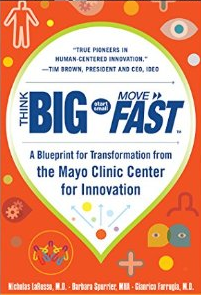
The innovation books on my shelf are typically written by designers, famous agency wizards, marketing gurus, etc., so it was surprising to see a title, co-authored by a team from the Mayo Clinic Center for Innovation, popup in my Amazon book recommendations. After all, healthcare is rarely (if ever) seen as a hotbed for innovation. Not only was it intriguing to see a healthcare provider launching into the innovation conversation, but its title caught my eye as well –Think Big, Start Small, Move Fast – A Blueprint for Transformation from the Mayo Clinic Center for Innovation.

So, what can the authors from Mayo – consisting of Nicholas LaRusso, M.D., Barbara Spurrier, MHA and Gianrico Farrugia, M.D. – teach us about innovation and healthcare marketing? It turns out quite a bit! The book probably contains 115 great tips and ideas that you should explore on your own, but here are the top 15 innovation insights that you can start applying right away.

Before diving in, this brief video tour of the Center for Innovation work environment will help you to put these 15 tips in context:

3 Core Principles
The title of the book –Think Big, Start Small, Move Fast is also Mayo’s trademarked operating philosophy and provides an excellent starting point for effective and powerful innovation.

  • Think Big. First, by thinking big and tackling important problems, the team at Mayo Clinic is able to help insure broad organizational support for its projects.
  • Start Small. Then, by starting small, complex challenges are reduced to manageable size, allowing the team to get immediate traction and tangible results.
  • Move Fast. Finally, by committing to moving fast, hypotheses can be tested quickly and interest in particular innovation projects remains high. The goal is to implement a major prototype of the concept within six months of launch. As Steve Jobs famously told his team at Apple, “Real artists ship.”

While the foundational principles of Think Big, Start Small, and Move Fast help power the overall innovation engine, at the core of Mayo’s innovation process is a deep commitment to the customer/patient experience: “Transformative innovation is an evolutionary form of innovation built on an undivided focus on the customer and customer experience… We constantly ask: Will our actions have the potential to profoundly impact the experience and delivery of health and health care?”

However, as you probably recognize, a mission statement espousing the importance of enhanced customer experience is not particularly unique in the marketing and innovation space. Where Mayo has differentiated itself is in terms of execution and long-term focus to this ideal. To make its vision of innovative patient experience come to life, the Mayo Clinic Center for Innovation has followed a carefully sequenced series of iterative steps over 11 years. In other words – building a genuine culture of innovation takes sustained effort over time, especially in healthcare.

To achieve this success, Mayo has narrowed in on “4 Habits for Gaining Deep Customer Insights” and “8 Executional Disciplines for Innovation.” Together, this innovation framework has helped it not only drive innovative programs throughout the Mayo Clinic, but also become innovation thought-leaders in its own right.

4 Habits for Gaining Deep Customer Insights

Customer understanding must go beyond traditional surveys and focus groups and identify the explicit, tacit, and latent needs. According to the authors, “the best innovations start by making the customer observations and doing the synthesis yourself.” This commitment to first-hand customer insight is realized through a number of customer-centric organizational habits.

  • Scanning and Framing. By constantly looking at broad trends – both within healthcare, as well as in a range of other industries, Mayo is able to uncover unique insights about the customer and then align those insights with its core strategies.
  • Experimenting. By constantly experimenting and measuring results, a clearer understanding of true user needs emerges, and allows concepts to be redefining.
  • Prototyping. A culture of prototypes helps to crystallize ideas and validate tangible models through a series of iterations.
  • Implementing. The end goal of broad implementation is kept clearly in mind. Solutions and innovations need to be scalable in a real-world context, not just in a small test.

8 Executional Disciplines for Innovation

In addition to these habits for delivering deep customer insights, Mayo has instituted a range of disciplines for building a culture that consistently delivers high levels of innovation.

  • Build a discipline of innovation. The Center for Innovation’s mantra about innovation is to “Build it, live it, champion it throughout the organization.” Commitment to innovation cannot just be lip service. True marketing innovation takes discipline and structure. The organization of the marketing innovation team is also important – allowing others outside the group to understand what the marketing team is doing, and how they can best align.
  • Recruit a diverse team. At Mayo, engineers, architects, product designers, and anthropologists are aligned with scientists and organizational experts to drive unique perspectives. How diverse is your marketing team? How often do you seek outside perspectives?
  • Embrace creativity and design thinking. For Mayo, failures are expected and tolerated in its pursuit of innovation. This Mayo video discusses their willingness to actually embrace failure!


How risk tolerant is your marketing team? Are you truly embracing creativity, and listening to your customers or just copycatting what other healthcare marketers are doing?

  • Environments matter. Innovative marketing is difficult to create in a cube-farm type of office space. Find a working environment that fosters Silicon Valley-style lab experimentation and collaboration.
  • Co-create with your customers and stakeholders. While it is tempting to “go it alone” with your marketing campaign, have you considered ways to incubate and accelerate you customers’ and stakeholders’ ideas, not just yours?
  • Organize around Big Idea platforms. Marketing innovation needs to address key brand strategic objectives. All projects must fit the big picture and vision.
  • Collaborate inside and outside. Encourage outside participation, partnership, and sponsorship wherever they make sense. In a rapidly changing marketing environment, some of the best campaigns are born from cross-functional, or even cross-industry, collaborations.
  • Consistently share your vision, process, and results. Be visible, and be easy and useful to work with. Marketing innovation cannot happen in a vacuum. Sales, commercial operations, customers, and other stakeholders need to embrace your innovative approach – otherwise your campaign will fall flat.

Conclusion
As you can see, the Mayo Clinic Center for Innovation has stepped up to meet the need for healthcare innovation in a big and meaningful way. It has also uncovered innovation principles that can help drive healthcare marketing innovation as well. When you have more time, Think Big, Start Small, Move Fast is well worth reading in detail.

Jim Walker


December 8, 2014

Innovation brings both opportunity and change, and this is true with emerging point of care technology. There is a pressing need for help in the three critical areas of Prevention, Diagnosis and Monitoring. But how can the industry get involved to help support patient care?

In the Fall 2013 issue of DTC Perspectives Magazine, I suggested that the real innovations in improving the physician-patient experience were no longer coming from the healthcare industry but from entrepreneurs, many of them new to healthcare. I argued that pharma in particular is essentially acquiescing to tech newcomers despite the fact that arguably there is no other industry player who is so integrally linked to innovations in the delivery of healthcare.

In the last few months, it has become clear that the leadership in consumer health innovation is in the hands of the large consumer electronics companies like Google, Apple, Qualcomm and Samsung, as well as mobile phone carriers such as Verizon and AT&T. While their focus is initially in the largely unregulated health and wellness sector, there is nothing inherently limiting them from moving into the clinical realm. In fact, Samsung has already declared they are making a $2 billion investment in building a pharmaceutical company. Early-stage startups, such as Trial Fusion, are building the capacity to manage the regulatory approval process for digital health products.

The business rationale is obvious. Healthcare is a growth sector with enormous inefficiencies. What’s there not to like about it if you’re an entrepreneur or an investor? Digital health is one of the fastest growing segments for investor dollars. By mid-2014, $2.4 billion had already been invested in digital health, more than in all of 2013. The typical reticence by investors to taking positions in startup healthcare companies has evaporated. According to Rock Health, there are at least eleven late-stage venture-backed health companies ready to IPO, which will bring in a flush of new public money to fund additional growth among these health tech firms. With market momentum shifting to consumer health technology and its ecosystem of venture capital and investment banks, is there still a role for pharma? How are these changes in consumer health technology impacting the physician’s office?

Technology in the physician’s office
The adoption of technology in the physician’s office has followed a predictable path of efficiency and automation. Early applications automated the billing, payroll and payer reimbursement functions. They included accounting systems, treatment codes and fax machines. The last ten years have seen the emergence of EMR platforms, e-prescribing and patient portals. These tools used Internet technologies and systems integration services.

The next wave of innovation will see a more comprehensive digitization of the provider landscape. An important aspect will be patient-centric digital health tools. These applications will fall into three functional categories:
1. Content apps will provide disease information, wellness apps, Rx information, social media platforms for discussing symptoms and remedies, etc.
2. Digital health tools will provide symptom and activity tracking, remote patient monitoring, and adherence support.
3. Rx integration will move technology into a direct support role for prescription drugs. These technologies will include companion digital diagnostic tools, decision-support tools for providers, and titration monitors.

Pharma was not a contributor to the early applications of practice management technology, but there is a strategy for pharma to play an important role in the next wave of digital health tools.

Impact of digital health in the doctor’s office
Innovation brings both opportunity and change, and this is true with emerging consumer and patient point of care technology in the physician’s office. Among the many challenges facing physicians today is the pending deluge of consumer and patient health data. There is an assumption that the various personal health trackers and clinical data sources can be monitored and triaged by primary care physicians, but there are not yet adequate tools to help patients and physicians use consumer health data at the point of care.

If you discuss this consumer health data trend with primary care physicians, many will even challenge the basic assumption that raw data generated by consumer devices will be meaningful in the first place. Physiological data is personal and must be assessed in the context of individual and family medical history. In addition, most primary care physicians are already overworked. In the case of new consumer health tools, innovation is not creating efficiency, it’s adding to the workflow. If digital health hopes to find a home in the doctor’s office, it must find a way to overcome the bandwidth limitations of physicians, or better yet, create more efficiency at the point of care.

How can industry help doctors overcome the constraints of what might otherwise be seen as a breakthrough in real-time reporting of consumer and patient health conditions? How can technology help extend the definition of “point of care” beyond the physical boundaries of the exam room without pecific arena of consumer health innovation. There is a pressing need for help in the translation of consumer health data to clinical practice in the three critical areas of Prevention, Diagnosis and Monitoring.

The “jobs” that clinicians perform
There are three primary clinical jobs – Prevention, Diagnosis and Monitoring – that primary care physicians perform. The first, Prevention, is a long-term commitment with the patient to avoid illness in the first place. During the annual physical, the internist and patient have a frank and open conversation about health and lifestyle choices, and often the physician will make behavior change suggestions to promote health. The second job of the doctor is Diagnosis. When a patient presents with a litany of symptoms, the physician will combine a thorough medical history, physical exam and diagnostic tests to determine a diagnosis and present a treatment plan. In their third job, Monitoring, clinicians follow up with patients, monitor treatment and encourage medication and behavior change to promote recovery in the acute setting and optimize management and quality of life in those with chronic illness. To provide value, the promise of point of care innovation must address at least one of these jobs.

Digital monitoring
Digital health tools can support a range of use cases, from wellness (weight loss, exercise, behavior change, education, tracking) to elite athlete performance management (sports, exercise, rehabilitation, nutrition) to clinical (remote patient monitoring, post-discharge tracking of key clinical markers, and titration monitoring).

Promising applications already exist to set personal health goals, track symptoms, encourage behavior changes and nudge medication  compliance. Patients receive real-time feedback on their progress towards recommended lifestyle changes. With some applications, the healthcare professional receives an alert when there is a significant aberration from personal baselines already established between the physician and the patient.

At this stage in the development of technology, the likelihood that a consumer activity monitor or mobile health device will provide unique data that is more valuable to a physician than a medical history is still remote. However, digital patient monitoring devices for chronically ill patients with diabetes, CHF, asthma or heart disease will soon be able to capture data on vital signs or clinical parameters that will be a helpful decision support tool in avoiding re-hospitalization.

The traditional, pre-EMR doctor-patient relationship didn’t empower the patient with the ability to track and monitor personal health data. This has already begun to change with the emergence of patient portals and consumer access to medical records, and patient engagement will accelerate as the difference between health & wellness and clinical digital applications fades, and the lines between regulated and unregulated devices blur. The physician-patient relationship is in flux and in need of fresh ideas and relevant innovation.

Getting started
There are two primary brand strategies that pharma can use to participate in digital health at the point of care. The first strategy is to make an unbranded commitment to the physician’s office. To maximize physician use, content apps and tools generally should be unbranded. Pharma’s reputation has not engendered enough trust with physicians to offer branded content for use in the physician-patient conversation. The goal of offering convenient and useful unbranded content is to build trust with doctors.

There are also opportunities to take a branded approach to digital health offerings, but there must be significant value in the integration of digital health into the pharmaceutical drug regimen itself. If providers see value in a custom digital app for remote patient monitoring, titration feedback, or as a source for diagnostic data, it is more likely that it will be adopted. The same thinking that goes into a successful drug launch should go into a successful digital point of care tool. The most effective approach will maximize benefits for the patient at the least cost – workflow and financial – to the physician and the payer. A successful digital health tool needs to offer a differentiated experience. The pharma marketing team should examine point of care needs and opportunities from the perspective of its own unique disease and treatment expertise.

Much more than the large consumer technology companies, pharma has a number of key assets – science, technology, data – that can be used to fund, design, develop and support both single and integrated solutions to help improve the physician-patient relationship at the point of care. Given the historical role that pharma has played in developing innovative pharmaceutical products that are prescribed at the point of care, there is a very real but narrow window of opportunity for pharma to reprise its leadership role, this time in consumer digital health. The time to act is now.
[Editor’s Note: This is the full-length feature from David Ormesher’s article post, “Consumer Health Innovation & The Window of Opportunity for Pharma”, from our e-newsletter, DTC in Focus.]

David Ormesher


December 8, 2014

The healthcare landscape has transformed rapidly in this technology-led, customer-controlled world and the discipline of marketing must evolve with it to stay relevant to the needs, motivations, challenges and behaviors of its audiences. We must flip the paradigm from one of gaining the consumer’s attention to one that reflects understanding of today’s empowered consumer and healthcare professional (HCP), and the healthcare journeys they experience.

To be relevant, a brand must immerse itself contextually at critical junctures across the healthcare journeys and deliver relevant and meaningful value across a multichannel landscape without arbitrary channel boundaries. The path to success in this customer-empowered and controlled world is in some ways quite simple. It is through the creation of tangible value for our audiences that we change mindsets, perceptions and intent, and create preference for our brands. This preference turns into proactive demand in the physician’s office, which in turn translates to more scripts. Each channel, program, campaign and tactic must work in concert toward this goal. Managing success, therefore, must follow this same path and begin with a common definition and understanding of success.

Step 1: Define success and set goals
Define the required shift in audience mindset, intent and behavior: Achieving financial outcomes through marketing is about changing customer mindsets. You must first establish specific goals for specific perceptions, intent and behavior that are necessary precursors to an active patient-HCP dialogue. Establish complementary patient and HCP goals that allow you to track the behavioral shifts and lifts. Keep in mind that it’s not only through primary market research that customer intent and behavior can be tracked; for instance, customer intent is quite visible in the volume and sentiment of social dialogue and search behavior.

Forecast the expected financial outcomes: Sales forecasts based on a direct selling model are meaningless in the world of DTC marketing. You must identify optimal touch-point and content consumption paths that are most likely to elicit behaviors that precede a script, to predict future outcomes with reasonable accuracy. This leads to more reasonable and relevant goals for the incremental contribution of DTC and HCP marketing.

Establish tactical objectives and goals: Ideally, by this time you would have configured a multi-touchpoint marketing campaign, programs and tactics to encourage the desired shift in consumer behavior. Each of these initiatives must have its own objective and KPIs (Key Performance Indicator); KPIs that are completely aligned with the overall marketing and customer impact objectives, complementary to each other to ensure multichannel synergies, and are actionable. These KPIs can be about reach, awareness, engagement and/or action.

Step 2: Establish data needs, feeds and warehousing
The next step is ensuring a mechanism to capture, transform, integrate and warehouse the right data. Data that can not only tell you how you are doing against your goals, but also why. The biggest challenge here might be breaking down the knowledge and intelligence silos that are prevalent in healthcare.

Step 3: Analyze, synthesize and disseminate insight
This is where an integrated, cross-channel, multi-audience approach is critical to truly understanding the interplay of various tactics and campaigns in driving desirable behavior. Leading indicators like interactions and source to destination analyses can give you early warnings of any tactical or operational issues and insight into what to tweak to get back on track. Don’t just distribute pretty charts that leave the “so what” question unanswered.

At the same time, ensure there is a contemporary mechanism in place to answer the inevitable ROI question. You should consider a “triangulation” approach to get to the answer; traditional econometric models are getting harder and harder to configure as the market and media landscape continues to disrupt old paradigms. But this is a topic for another day.

Step 4: Create a continuous optimization loop to revitalize communications and reconfigure strategy
Optimization of media tactics and placements is a real-time activity. Content can be energized on a monthly or quarterly basis. But, most importantly strategy must be informed in sync with the changing market environment, or at the very minimum every brand-planning cycle.

To summarize, in order to optimally manage brand success in today’s market, you must first clearly define success and then establish financial, customer and communications goals. All along, collect and analyze the right data to establish how you are doing and why, disseminate insight, and ensure a continuous optimization loop that allows for timely alterations in tactics and ongoing relevancy of your strategy. Rinse and repeat.

Mukarram Bhatty


November 18, 2014

For years, marketing has begun with the brand, the campaign, and the big idea.  It has been shaped by what we want to say, how we want to say it, and how many times we want our “targets” to hear it. We would spend months and months developing headlines, copy, TV spot, print campaign, email and banner ads. Then, at the end of the process, we’d call the media team to find a place to stick it. Of course, the best places where we could “hit” as many people in our target audience as possible. Often not realizing that we shared this audience with our competition.

Many brands in healthcare tend to focus on women aged 35-64, either they suffer from the illnesses we aim to treat or we believe they hold the keys to every healthcare decision in their household. This is why for years, and even now, shows like the Today Show look like they our sponsored by big pharma and healthcare; we have been stuck in a game of “whack-a-mole,” trying to hit our target with our message as many times as possible, with a goal to change her behavior.

We need to remind ourselves that health is a journey like no other. From the moment we are born, it begins; from boo-boos and scraped knees, to getting fit, giving life, battling illness, the health journey is something we all have in common. It is a journey that is continuous, challenging, and sometimes rewarding – but always requires fortitude – from within and from without.

Health is a journey that matters. It’s one of the reasons that health is one of the most searched categories on Google, and the most discussed topic in social media; the reason that there are 1.2 billion pages of web content dedicated to health and wellness, and that half a trillion dollars of investment have been spent there in just the past 10 years.

Health is a journey made up of moments; moments that are full of emotion, decision and action. Moments that require us to take a step back and make sense of a new situation, to assess, learn, ask advice and seek answers. It is time to stop thinking first about the big idea and the campaign, but to begin our thinking with understanding where these moments and conversations happen. Basically shift from a media last mentality to embracing a media first point of view.

Media’s Evolution

For years media was the afterthought. When we were in a “tonnage” game this was fine. We were able reach the majority of our audience through prime time television and print. And let’s be honest, shooting the TV spot and the print campaign were much more sexy than talking about TRPs and reach frequency curves.

However, today, media is changing faster than advertising. If Facebook were a country, it would be the third largest country behind India and China. According to comScore (May 2, 2014), 166 million people in the US own smartphones (68.8% mobile market penetration). These stats were not the case only 12 months ago. I believe media is the new black and where the sexy is happening.

Media has moved beyond spots and dots and impressions, to delivering critical information about what our customers truly want, how they want to engage, and where they gather information across their health journey. It’s beyond buying space. Media agencies today are working with publishers and producers to broker content deals. This is happening because our customers don’t want to hear everything from the brand. Furthermore, in pharma there is only so much we can say. However, we need to realize our audiences need more support and information than what is prescribed on our label.

Publisher partners can lend credibility and a trusted voice to help meet the needs of our customers. Oftentimes they can deliver the content our audiences desire faster and more cost efficient than creative agencies. For example, if your audience requires information around food, why are you creating the content, and not Food Network? If your audience loves music, why aren’t you streaming content from Pandora? Media agencies can help identify and develop partnerships with these types of publishers and move you from simply selling your brand to providing a service.

So, next time you are kicking off a campaign, thinking about your next big idea, I encourage you to look around the room and make sure your media team is present. Health is different. It is the only journey we are on that never stops. As brand marketers, we need to know where and how we are going to show up, not just what we want to talk about.

Matt McNally